I have made two trips to Atlanta, a wedding and then a funeral, unfortunately involving the same family. In the middle was a week in Richmond with Cousin Jack doing history. Returning that week-end I attended the North Carolina Chapter of the Sierra Club's 40th anniversary gathering near Washington, NC. It was great seeing old friends again. There was also another funeral, this time in Virginia, one of my oldest and best friend's mother. She was a wonderful lady I always enjoyed visiting. On that trip I spent time in the UVA medical library learning more about my great-great grandfather Dr. Lemuel, time well spent. While this was going on the hot summer weather broke, providing opportunity and incentive to finish household projects. I can now walk around our garage without putting life at risk and the rails on the back porch are finished. My to-do list from six months ago is considerably smaller, although far from finished.
And last week much of our extended family met in Hilton Head, SC for our annual week get-together, a tradition started by my mother years ago. This year we forsook the middle of summer at Duck, NC, but and found the beach at Hilton Head in October wonderful, the water warm, the weather perfect. We had very nice accommodations, plenty to see and do, good restaurants, and off-season crowds. Everything was "no problem."
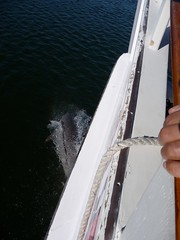
It was great hanging out with the family, especially the two grandchildren, Wil and Lily. But what I will remember from that trip is the tour we had of nearby Daufuskie Island ("the only place in the world where nothing normal ever happens.") and our guide, Roger Pinckney, he of the previous quote. Here is a photo of a dolphin along our bow on our way to the island.
As I am less than 24 hours from heading out on a two-week road trip that will take me to the banks of the Mississippi River and back, I don't have time to gather my thoughts about that tour. From the homemade tape of remembrances made by the Captain of the boat that took us to and from the island - a boat by the way that recently ran from Reedville to Tangier Island - to the stories of the Gullah inhabitants and the tangling up of developers and Dr. Buzzard, the tour was as perfect as the resorts on Hilton Head strive to be - but in a completely different way.
"Dr. Buzzard?" For those curious, link here, here, and/or here. You will then understand why I enjoyed that trip to Daufuskie so much.
My memories of days spent at the Chase City Community Park pool were triggered this spring by my current role helping maintain the community pool where I live. Yes, I am a pool boy again. No lifeguard responsibilities this time, no pay, just volunteer pool maintenance and cleanup.
Some things have changed in 50 years, others have not. There are many more rules to ensure the public a safe pool. On balance, a good thing. The public, however, has changed little. That subset of unnecessarily messy adults and their annoying brats are still with us.
As our pool season ends this week, it is time to bring this mini-series to a close with a first person account of the most memorable morning in my lifeguard career.
At Deercroft we routinely test the pool water every morning for five or six chemical attributes. To keep the water safe and pleasant we have a variety of chemicals that can be added to maintain acceptable parts per million of whatever. In the early '60s all we had were 55 gallon drums of granulated chlorine (probably calcium hypochlorite), a bucket, a simple ph test kit that always seem to register the same results, and the burning eyes of small children.
Working drums of chlorine were kept in the concession area near the basket racks. Every morning one of us would place a bucket next to the drum, remove the metal lid, and, with a new paper cup that would otherwise be used for vending soft drinks, would fill the bucket. After closing the drum and throwing away the cup, the chlorine would be dumped into the pool, rendering the water bit more sanitary than before. This procedure had been passed on from one lifeguard to another for years. Old drums would be recycled as trashcans around the Park, although we would have not used the word recycle back then. We kept one such inside the concession stand on the other side. No problem.
There were, even in those days, warning labels on the drums, lots of small print basically advising care should be taken to keep contaminants out of the chlorine. Bad things could happen. No problem.
This particular morning I opened the drum to find a cup already lying in the chlorine. That sometimes happened; one of us would forget to throw away a used cup. This morning, in the interest of time or laziness, I picked up that cup, scooped some chlorine, and began filling the bucket. After about three scoops as I reached down into the drum a glob of something fell out of the cup and into the chlorine. It started to pulse a bit and then took on a deep blue glow. I bent over into the half-full drum, to get a closer look at the electric color. Within a few seconds a wisp of white began to rise from the glob, almost like smoke. The blue glob became yellow/red around the edges. Marveling, I stood up and turned, calling to Patsy, my fellow lifeguard. I wanted her to see this!
Patsy, who was already in the concession stand, started to walk toward me. Then she stopped mid-stride. Her face froze, her considerable tan started to blanch. For a moment I wondered why she had stopped. Then I heard and felt what was happening beside me. I turned to see large globs of white exploding from the drum shooting towards the ceiling; there was heat, smoke, the smell of chlorine, and a roar coming from the drum.
We probably set some sort of record for vacating the premises. I took the short way over the countertop, I think. For maybe a minute we just watched as molten chlorine was ejected into the concession stand all the way to the roof. Boxes of snacks stored above the shelves starting smoldering. I had never seen a volcano, but this was close enough.
Snapping out of my daze I ran to hook up the water hose. Soon a spray of water had joined the finally diminishing chlorine being ejected from the drum. I noticed the drum had turned black from the heat, the warning labels burned to a crisp. Layers of white chlorine smoke filled the concession stand.
When the drum had stopped erupting we carefully went back inside. Any danger of fire had passed, although the wet white globs were still too hot to touch. Having determined that this morning’s events were beyond keeping to ourselves, I headed for the phone. My father was president of the Community Park that year, I would call him.
The phone had been very close to the drum. It was a standard black, rotary dial phone. The black plastic was now melted. Salvador Dali would have been pleased. I picked up the still warm receiver with two fingers. A dial tone. God bless Western Electric. The only number I could remember was my own, so I called home. I told mother with as much cool as I could muster that there had been a chlorine accident at the pool and to call dad. It was a very short conversation as I was determined to clean up as much as I could before he could get there. I already had some practice at this. Besides, it was close to noon and we opened at 1. Then the fire truck arrived.
Living in a small town has its advantages. Keeping bad news quiet is not one of them. A neighbor had seen the smoke and called the fire department. Under most circumstances I would have been happy to see them. Except we had no fire and all this mess was both my responsibility and my fault. About the time they were turning to leave, a little disappointed it seemed to me, my father arrived. The place looked pretty rough.
After explaining that no one was injured, there was no lasting damage, and we would get the place ready to open on time (I was probably talking REAL fast) I noticed that I was having problems breathing. The harder I tried, the worse it got. I then thought of the chlorine gas I had been breathing and something about WW1. Keeping cool - I was a lifeguard after all - I walked down to the pool to lay down, trying to make it easier for anything in my lungs to leave. While I was doing that, my father walked about assessing the damage. After about 5 minutes I stood up, pronounced myself cured, and grabbed a broom and tried to look busy.
Dad left, in character, saying little. We cleaned up and opened at 1. The place still smelled like chlorine, there were charred boxes to dispose of, and there were - and a few years ago remained - scorch marks on the wooden ceiling. For the remainder of the day and that summer season I answered questions about the incident. Using glass coke bottles I even replicated the chemical reaction on a small scale for the amusement of small children. The phone company guy replaced the phone, no questions asked.
What had happened was easy to reconstruct. Someone had mistaken the working drum of chlorine for a trash can and tossed in a cup with a small amount of a soft drink still in it. It had landed so the liquid was still in the cup when I started scoping the next day. I had mistaken the cup for a dry one used the previous day, never considering what might be inside. I had had only a short window of time to scoop out the glob as it smoldered, but I played empiricist. Had I not decided to share my discovery my head might have been still in the drum when it erupted violently. Remember children, it is nice to share.
I did not bother applying for a job at the pool the next year; it was time to move on. So I spent the next summer packing blue jeans at a local cut and sew factory. More money, much less pleasant working conditions, and extra motivation when I left for college that fall.
I don’t remember visiting the Community Park pool much thereafter. After I went away to college I devoted summers to seasonal jobs, summer school, and golf - not necessary in that order. Our local country club by then had built a small pool which satisfied any aquatic desires I had. But to this day I cannot visit a pool without looking about for drowners, wondering about what kind of filter system it uses, and where they store their chlorine.
The Community Park pool closed sometime in the 1970’s. The circumstances of its closing has been mercifully forgotten as it likely reflected the unsettled racial politics of the times. It was soon filled in, the diving pool corner later excavated and used to expand the adjacent baseball diamonds. The Bathhouse/Concession stand still stands, renovated for storage, recenty painted but a bit worse for neglect.
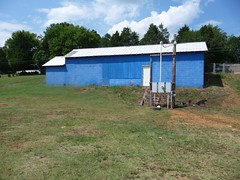
Here are some photos I took this past summer. The first photo was taken from the approximate location of the lifeguard stand. The small addition on the west (left) side of the building is a storage room was built after that fateful summer in 1962, mainly to safely store chlorine. I doubt anyone thought to name it after me.
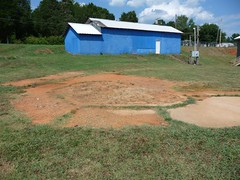
The second photo shows the little remaining evidence of the pool. In the foreground is the area where the baby pool was and a small fragment of concrete apron. The baseball field is to the right.
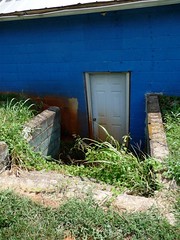
Finally, below is the portal through which a generation of Chase City youth once streamed to learn to swim, hang out with their buddies, show off, and blissfully wile away summer afternoons. Few now remember how much has been lost.
Shuuuch! Don’t tell anyone. Floydfest was - once again - simply wonderful. Don’t pass it on.
The cool, damp, and small music festival in the Blue Ridge Mountains of Virginia is no more. It has been replaced in the past couple of years by a festival of sunshine, dust, and much larger crowds. However, the mountains, relaxed vibes, and great live music - at least for the time being - remain. Every year Across-the-Way Productions has improved the facilities, ironed out kinks, and managed well the growing numbers in attendance. But scaling is seldom straightforward or fool-proof. If the cheek-to-jowl camping and the Saturday evening crowds are prologue, Floydfest is quickly approaching a crossroads of size and, unfortunately, purpose.
Having attended the last seven of the nine Floydfests, I am noticing a declining percentage of attendees who seem to be there for the music. (It seemed over 90% early on.) Many give the impression of buying their tickets to party in the mountains with their friends; others are there to see, and be seen. These are long-standing and honorable human desires; they have their place. But it remains an open question if Floydfest can maintain the main attraction that drew me there in the first place: accessible, first-class live music of all descriptions in a relaxed friendly environment.
This year - besides the cast of thousands - it was only me and Anita. She had been unable to attend last year due to a severely mangled toe; but despite having a knee operation this year only six weeks earlier, she toughed it out, icing her swollen knee at every opportunity. Missing this year was my daughter (she of the food processor and home-made baby food), who blogged about it anyway, Donna The Buffalo, and A Joyful Cup, vendors working from a converted school bus who had provided early morning coffee and smiles as far back as my Floydfest memories extend. Not exactly replacing them, but a welcome addition, were the folks of Floyd's Red Rooster Coffee Roster. They provided free high-quality, fair trade coffee behind the stage and joined the festival vendors near the Garden Stage entrance. Nice folks. I bought some beans; you can too.
We camped near the main stage just a few feet from the loop road, aided by Anita’s Handicapped tag. We had driven up Wednesday night and stayed in a B & B in Floyd to get an early shot at a camp site with as little up and down as possible, close to potties, food, and the music. That turned out to be a very good idea. We were quickly surrounded by this year's new friends, tent stake to tent stake.
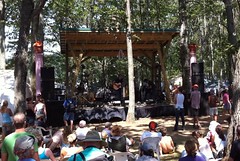
Before I launch into the music, here is a visual example of what makes Floydfest and the people who put it on so special. This is the Pink Floyd Garden Stage. Notice dead center a few feet out is a tree. Most folks would have cut it down to provide a better sight line for both the performers and audience. But it remains. It was there first, does not really interfere with the music. So they let it be. Where else but Floydfest?
For me this year’s main music lineup attractions were The Levon Helm Band, Railroad Earth, and GPN. I had heard of, and wanted to hear, several others, including The Budos Band, my nephew Kevin's excellent recommendation, and Old Crow Medicine Show, my daughter's Don't Miss! suggestion. As usual, most performers were complete unknowns to me. But first...
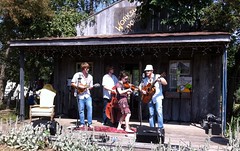
My old friend Tom - since elementary school - owns an electronics store in Johnson City, TN. On my all too infrequent visits he invariably takes me into his high-end listening room to sample some amazing musical recording. This spring he surprised me by playing a homegrown cd by a local group of ETSU college students. They played both traditional old-time mountain music plus originals based in the same genre. He liked it. I liked it too. He showed no interest in parting with the cd. He told me that he had talked with the fiddle player and found that she grew up in North Carolina, north of Durham, not far from where we had spent our youth in southside Virginia a generation earlier. Back home I found their website and learned they were scheduled to be at Floydfest. I was delighted. So Friday morning when The Barefoot Movement opened the’s Workshop Porch, we were there. Their music was as good, bright, and fresh as I remembered.
They played three more times, all on the VIP stage to a smaller crowd. I talked with various band members several times over the week-end, learning that Noah, the fiddler, had attended Floydfest 2 when she was a high school freshman and wondered at the time what it would take to get behind those Performers Only signs. Now she knows. Her story - to me at least - is a fulfilled promise of Floydfest, passing on the music. They were recording their first full length cd this past week. I wish them well; may the Movement continue. I hope to see them at Floydfest 10. Here is a video I made of them on the VIP stage...
Returning from two years ago were the Rockridge Brothers, who describe themselves as Sweden's "Old Time Appalachian White Collar Punks." What a bunch of guys from Stockholm are doing playing traditional Appalachian music, I just don't know. But they are playing it with skill, care, energy, and obvious respect. They are much more confident on an American stage than two years ago when I first heard them, working on more than their English. They opened the Hill Holler Stage Thursday at 4. Fun too. Listen/Watch them on YouTube.
Returning from last year was Jesse Chong. I voted for him as best artist in the Under the Radar Contest last year. This year too.
Kevin's Budos Band rocked the main stage with their "Staten Island instrumental afro-soul" sounds mid-afternoon Friday. They were much more musically worthy than Thursday night's closer, Galatic, about which nothing more will be written.
Railroad Earth, about which I have blogged numerous times, closed Friday night. It was the first time I had heard their new bass player. While it will always seem odd not to see Johnny Grubb on the stand up, the new guy - Andrew Altman - fits in quite nicely. As usual they stretched out a bit musically Friday night for the Floydfest crowd. Earlier in the day RRE minus Todd and Carey played a bluegrassish set on the Workshop Porch. The boys then beat it to upstate New York to play Sunday at Donna the Buffalo's Finger Lakes GrassRoots Festival.
Saturday was full of surprises. First were the freshened mountain winds that had been mainly absent the first two days. The constant movement of air helped moderate the effects of the unusually warm, sunny weather. Second was the strong progression of performers all day on the main stage. Sol Driven Train, William Walter, The Hackensaw Boys, Adrienne Young, Bearfoot, Bassekou Kouyate & Ngoni ba from Mali, J. J. Gray & Mofro, Old Crow Medicine Show, Kat Mills, and The Levon Helm Band. And joining Spiral this year was Miss Kitty. Here was the price of admission in one day, in one place. I am truly at a loss as how to blog about this Saturday lineup. In different ways, all just lit up the stage. Amazing. I slept well that night, probably with a smile on my face.
Occasionally the moment transcends the music. Floydfest had such a moment Saturday night when Levon Helm took the stage. His place in American musical history has been long secure, his contributions well noted. And even though the throat cancer that could have easily killed him a decade ago has taken away his distinctive Arkansas tenor, one can still find him at 70 years old behind a drum kit, time suspended, leading his band on a Ramble. Seeing his smile and sharing that stage with him Saturday night is something I will not forget. An aside...
I never saw The Band, but I have seen all of its members. They were the Hawks, backing Bob Dylan on November 28, 1965 when I saw him at the old Washington Coliseum. Helm quit the band after that show citing the continuing hostility to Dylan's new electric music. He returned after about a year of working on oil rigs in the Gulf of Mexico. Good choice. All I have now to remind me of that show is a handbill for Dylan's upcoming show in Norfork I picked up on the way out. The closest I will come to seeing the Band was last Saturday night.
Sunday for me was striking camp, Tiff Merritt, and getting ready for Grace Potter who was to close from the Hill Hollar stage at 4. I have blogged before about GPN, with growing amazement. I had seen Grace live twice since Floydfest last year (Wilmington & Richmond) and I have found myself down front each time. Since last year GPN has truly been swept up in the starmaker machinery, to borrow a phrase from Joni Mitchell who knew what that meant. Rolling Stone has discovered them. Hollywood Records (Disney) is heavily promoting GPN and the new record. They are all over YouTube. They have recently been "musical guests" on Boob Tube talk shows (Leno, Kimmel, Good Morning America, Ellen). GPN's cover of "White Rabbit" was featured in Tim Burton's version of Alice in Wonderland. Disney again. And probably by design, even though the newly enlarged band is starting to sound like The Nocturnals w/Grace Potter, on stage she is heating-it-up. Writers are straining to find comps. My current favorite is from Amazon.com,
"Grace Potter and the Nocturnals are like a modern-day version of Tina Turner stroking the microphone in a spangled mini-dress while fronting the Rolling Stones circa Sticky Fingers."
Well, that certainly clears up things.
Grace is certainly on "Some Kind of Ride." With all the energy sapping attention of her band's growing stardom I can only hope she manages to keep her head together, remembers that at the bottom it is the music that matters. I hope she makes the time to write, what I consider her most basic strength as an artist. I wrote almost a year ago,
"I don't know if Grace Potter and the Nocturnals are the future of rock and roll. But if the music has a future it will be someone like Ms. Potter who keeps it alive. "
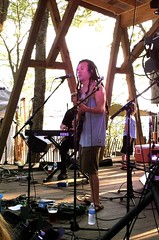
So Sunday I was down front again. GPN came out and again there was no place on earth I would have rather been. The band looked like it was having as much fun as the audience, maybe more. Grace was not quite as steamy as on Brown's Island, but the sun was still shining and there were children about. I did get a few shots of the band, enough to fill up my memory card. Here is the best of the lot. What a way to end the week-end.
The musicians highlighted above were probably less than 10% of those at Floydfest I would have enjoyed hearing. Every year my biggest Floydfest regrets revolve around thinking of those I missed, and some of my friends and family not there to share the music with me. Maybe next year. Which leads me to...
I had the opportunity to chat briefly with Erika Johnson, Co-founder and Director of Floydfest behind the main stage Saturday. She said they were planning something special for next year's 10th anniversary. Maybe a Best of Floydfest. I wonder if she is considering adding a hurricane, fog, or a power outage;) Better get your tickets early. I will.
By acclimation the Best Camper award this year goes to Mr. Scott, Anita's new Prius. The spaceship hatchback comfortably carried us and all our gear, the SatNav provided directions (which proved unexpectedly useful), and the mileage was exceptional. He endured the four-day layer of dusk with dignity and even found a rainstorm to drive through to wash it off before we reached home. One smart vehicle, one great week-end.
When I posted about South Africa several weeks back football's World Cup was just in its opening group phase. Despite being the world's most widely-viewed (popular, important, followed) sporting event, it remained to be seen whether the quality of play and the unfolding of events would make this Cup entertaining as well. With only the results of championship match between the Oranje and La Roja in doubt, that question has been answered. It has been magnificent.
The team from the United States played well, to be commended both in qualifying for the Cup and making it to the round of 16. But that was as far as they went, and as it should have been. Despite the growth in the sport's participatory popularity, the U.S. still does not field a first-tier national team. This year we were gutsy and lucky rather than excellent; others were all three - and that is what it takes to move on. The U.S.'s time is coming.
But three teams with far more talent and experience failed - very publicly - to get that far. The English side, with amazing individual talent, failed to become a team. The Italians, Cup winners four years ago, just played poorly. But for drama no team could top Les Bleus; they simply self-destructed, their quest cut short by a player's simple suggestion at halftime that the manager, "Va te faire enculer, sale files de pute!"
On the other side was inspired play from teams from South America not named Brazil and Argentina, emotional and exciting play from the teams from Africa (whose time is coming as well), and good showings from asian teams. Yes, there has been a moderate amount of controversy on the field - cards given or not, an offside call blown now and then, and one goal unfortunately missed. But, so far nothing resembling the Hand of God or a brutal head butt. Drama? How about Uruguay/Ghana.
The story lines have been interesting and the play of high quality with a minimal amount of rough-housing or on-field theatrics. Two very worthy sides who have never won a World Cup will be playing each other on Sunday on a continent hosting it for the first time. Ah, this time, it has beenThe Beautiful Game.
I'm already looking forward to 2014, when Brazil hosts the World Cup.
As a rookie in 1961 I was fortunate to fall under the influence of two lifeguards who put up with me and taught me everything I needed to know about running a pool. For a summer they gave me the illusion of having two - quite different - older brothers.
Carl was the Manager. He was quick with a smile, always in good humor, and full of stories - some repeatable. With Carl a bit of mischief was never far away. His recipes for Purple Jesus and other like refreshments served me well in college. He seemed to enjoy life, good times, and working at the pool; but he took being a lifeguard very seriously. For you girls from Chase City who would like to see Carl without his shirt just one more time...
Andy, the other lifeguard, was the smart one. Of the three of us, he was the most quiet, the one who seemed to be always thinking about something. Yet ever so often he would hold forth at volume and length, sometimes on topics neither Carl nor I fully appreciated. I remember one extended monologue about the Infinite, a topic that seldom came to my mind in those days. Another morning he mused as to why men had nipples, again searching for answers to questions no one else seemed to be asking. He drove an ancient, black, Model A Ford that bounced and rattled as if it was going to fly apart as it approached the speed limit; the faster it went, the bigger his smile. But sometimes that smile seemed to be coming from someplace far away. No surprise, he became Dr. Andy, a professor of psychology and university administrator.
For what I learned that summer I should have been paying to work there.
Much work around the pool, as I said, was custodial. We had to keep the water clean and chlorinated. The grass needed to be cut, the trash picked up, the changing rooms and toilets cleaned. But once the door opened our attention turned to the customers, mainly the youth of Chase City. Grownups actually in the pool were a rarity. At its most basic we were supposed to keep the children from drowning, hurting themselves or each other, and following the pool rules. Other than that they were free to have as good a time as their imaginations would allow. Being a lifeguard turned out to be great preparation for my years as a teacher and principal.
Precious little swimming goes on in your average public swimming pool. They are wet, dangerous playgrounds. Usually when children injured themselves it was because they slipped and fell down. The consequences of running on wet concrete are thoughts which seldom rises into the consciousness of young people. Thus our customers were always in motion, often screaming for no apparent reason. One loss of balance or unusually rowdy incident and stories would be told at dinner tables around town that evening. A major thread within these narratives was how the lifeguards handled the situation. For as we were watching the children, parents were watching us. One learned to be easy with the whistle, quick with the stare, and plentiful with the "Yes, Sirs," and Yes, Ma'ams."
I learned from Carl and Andy one could not watch everyone all the time. Accordingly patrons were divided into two rough categories: Swimmers and Drowners. Because we tended to see the same children throughout the summer, lifeguards quickly knew how well most of the town's children could swim, who was getting in over their heads, literally or figuratively. Thus, we naturally focused our attention as we scanned the pool on those most likely to sink. Strangers required special attention until we could tell how well they could swim. Made-for-YouTube moments like jumping into the pool and pulling out someone were seldom called for. In fact, if you were doing your job, incidents like that could be avoided by intervening early with a struggling swimmer. Only once in my two years on the stand did I need to jump in and pull out swimmers as the Red Cross classes trained me to do.
Brothers I had never seen before joined a crowded pool one week-end. The elder was about 13 or 14, the other about 9. Both were weak swimmers, but seemed not to know it. It was that second observation that bothered me; they became Drowners. About an hour after they arrived the older brother jumped off the diving board. His little brother jumped in behind as he came up. He swallowed some water, panicked, and grabbed his older brother from behind, knees gripping his back, arms tight around his throat. The older brother gurgled and both sank like a stone. By this time I was already going down the lifeguard stand. It was too late for Reach or Throw; it was time to Go.
I found them at the bottom hardly moving. I approached from behind. Grabbing the younger boy underneath his armpits, I used my feet to pry him off his brother. Rising to the surface I pushed him to the side of the pool. By then the older brother had bobbed up. I pulled him to the side also. Bystanders helped them out of the water while I took the pool ladder. As I walked by I squatted down and calmly suggested they take a break for a while before going back in. The normally noisy pool had become almost silent. Someone handed me my prescription sunglasses which had gone flying. As I climbed back up the stand and started to towel off I felt people staring at me. Then, as things were getting back to normal for everyone else, I noticed my legs were starting to shake, my knees felt like jelly. My breathing was shallow and more rapid. No telling what my pulse was like. Patsy, the other lifeguard, came by to take her shift. I waived her off for a few minutes until the adrenalin rush subsided. I was not sure if my legs would take me down the stand.
If that incident was the high point of my career as a lifeguard, the low point would occur soon after, one morning before the pool opened.
In the mid-1950s, when it was probably as prosperous as it would ever be, the civic-minded of the small town of Chase City, Virginia decided to build a swimming pool. A non-profit was formed, money raised, a loan taken out, and construction begun. Soon they had a place for their youth to learn to swim, boys and girls to show off as close to nekked as local standards of decency and fashion would allow, and mothers to dump drop off their children - to be relatively well supervised - for a few hours of peace and quiet at home. During the summer it was Chase City's afternoon center of youth culture, from one to nine, seven days a week. It was the Chase City Community Park.
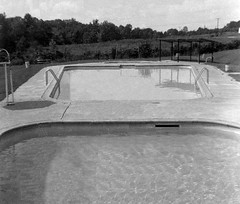
The design was straight forward, three pools. The center main swimming pool varied from 3 to 6 feet of depth. At one end a baby pool was in front of the covered area at the top right in this 1961 photo. At the other end a 10' deep diving pool was to the right of the lifeguard stand which faced the cinderblock building containing the entrance, changing rooms, and concession stand. The pool water filter was located underground, just behind the lifeguard stand. This photo was taken from the diving board.
Operating the pool on a daily basis was a staff of local teenagers. There was a manager/chief lifeguard, an assistant lifeguard, and someone to oversee the admissions, changing rooms, and concession stand. The pay was low, the hours long, and the work contained a large janitorial component. But it was as close to Baywatch as could be found in our part of southside Virginia. Accordingly, there was no shortage of job applicants, most reasonably qualified. I was among the fortunate; during the summers of 1961, '62, and '63 I held each of the positions above in reverse order. I was a pool boy, with a whistle.
My assent to the lifeguard stand was a bit unlikely. My mother, a non-swimmer, was afraid of the water; she did her best to pass on her fears. On the other hand she wanted me to learn to swim, driving me on summer mornings what seemed like many miles for lessons at Clark's Pool. I managed to ignore the mixed messages and became as a minnow, one-with-the-water by the time I was about twelve. After taking the regular Red Cross sponsored swimming classes all that were left were for lifeguard. So I signed up for those as well.
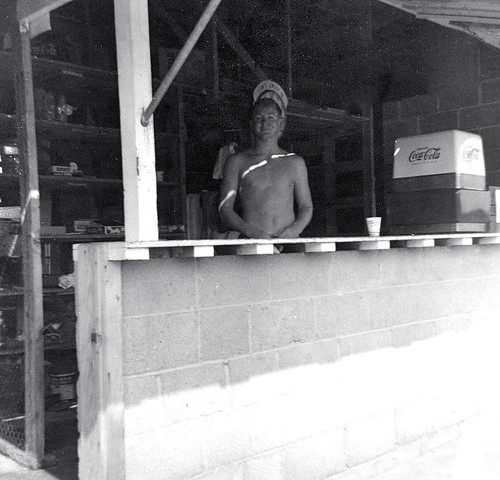
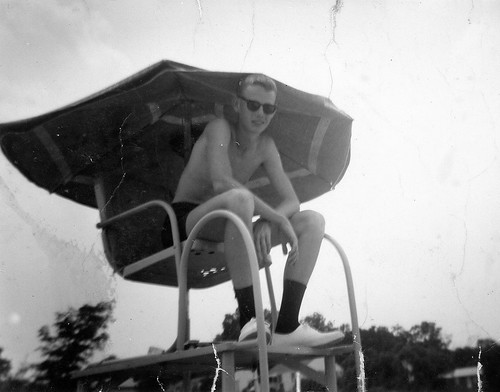
In the summer of '61 when I was fifteen I was hired to operate the Community Park's concession stand. Although I was all of 5' 6" and weighed - dripping wet - 100 pounds, I was already a Red Cross certified Senior Lifeguard. (I may have lied about my age... OK, I lied about my age. Practice for buying beer a few years later.)
The photo above was taken two years later, after I had shot up six inches and gained maybe 30 pounds.
It was my first job, fifteen dollars a week. Averaging ten hours per day, seven days a week, I was making about 21 cents an hour, and worth every penny. That summer I had a learners permit in my wallet and a job at the pool. Life was good.
But this post is not about aqua-phobia or minnows, job descriptions or wages. It is an introduction to why I did not work at the Community Park in summer of 1964.