 It has been about a week since HELL FROZE OVER. So far both Boot Camp and Windows XP have been performing flawlessly. I'm not surprised by Boot Camp - beta or not - but XP is remarkably better than the other half dozen Microsoft operating systems I have used. I still remain booted into OSX most of the time.
Friday, April 21, 2006
Analog Man Does Windoz
It has been about a week since HELL FROZE OVER. So far both Boot Camp and Windows XP have been performing flawlessly. I'm not surprised by Boot Camp - beta or not - but XP is remarkably better than the other half dozen Microsoft operating systems I have used. I still remain booted into OSX most of the time.


Wednesday, April 19, 2006
Rooms w/view

While walking to the Field Museum across Grant Park I took this of one of my favorite Chicago buildings.
Several years ago, one cold, windy but sunny morning, I was headed across the park to the Field Museum when I turned my back to the wind for a little relief. Until that moment I had not really taken in the magnificent Chicago skyline. My jaw dropped. So instead of the warmth of the museum I decided just to walk around and look at buildings. Not particularly dressed for the occasion, I like to froze.
The memory of this building, while not the most spectacular or famous downtown has to offer, stuck with me. Although the architecture is sort of typical of a century ago, it was where it was placed that caught my eye.

Here is another view. Makes you wonder how they got it up there.

P.S. Did you like that "like to froze?" My county boy personae peakin' round the corner.
Monday, April 17, 2006
Any Damn Fool
 The morning after Phil's party I stopped for breakfast at the Machine Shed in Rockford, IL. While settling up I noticed this book for sale on the counter, Any Damn Fool Can be A Farmer - Growing Up on a Wisconsin Farm, by Bob Knopes. I am working on a family history project of my own - and it looked like a good airplane read. So I bought it.
Turns out that Bob grew up just a few miles from where I worked in Janesville, WI. I must have driven past his family's farm hundreds of times. Small world.
What makes the book worthy of his efforts and yours - besides the writing which is much better than typical books of this kind - is the reminder of a way of life that is fastly disappearing. Family farming was - and is - hard work. It is reassuring that it usually does not make hard people.
Bob's story may not have enough drama for some; I'm sure that was just-as-well for his family. A couple of fires will have to do. But it is as real as that wonderful smell of earth being turned about now on Wisconsin's farms. I recommend it, especially to my friends along the Rock River.
P.S. - In case the book's title offends our friends in the agricultural community, Bob is referring to something his father often said, but did not really mean. Barnyard humor.
Friday, April 07, 2006
Phil
 The real reason for my trip to Chicago was to attend my ex-boss' retirement party in Wisconsin. I didn't tell them I was coming; it was wonderful seeing the looks on my co-worker's faces and be able to thank Phil for being such a great boss.
It has been a full two weeks since Phil's party - and post party - plenty of time for the $500,000 in small bills, the two Dallas Cheerleaders, and the case of Glenfiddich to arrive. Since Phil has obviously decided not to be extorted, I am making good on my threat to post this photo.
Wednesday, April 05, 2006
Field Day
 After my trip to the Field Museum I went downtown to pay homage to the enterprise that played a major role making it all possible, and do a little shopping.
Marshall Field's may or may not have been the world's greatest department store, but it remains my favorite. Although immitated, the atriums remain wonders to behold.
Marshall Field was a country boy from Massachusetts who moved to Chicago in 1853. Clerking in a dry goods store he saved his money, bought into the business, bought out his partners, and became the richest man in Chicago.
 His State Street store was as commercially innovative as it was beautiful. I wanted to take my own picture of the Tiffany iridescent glass ceiling five stories up, but found the floor traffic too dense. So I lifted this from Google Images. But photos cannot do the place justice; one must stroll about.
Fields had gone through several corporate owners recently and unfortunately will be rebranded as Macy's this year. That may be good for Federated Retail Holdings, Inc., but it will be another part of Americana lost.
P.S. I got some great pants on sale!
Monday, April 03, 2006
Soldier Field - Chicago
 After walking about in the Field Museum for six hours week before last I decided to get some fresh air. Soldier Field is next door, so I walked the colonnades.
The stadium finished undergoing a renovation several years back, the new architecture making for some striking juxtapositions.
 This photo was the best I could do showing how the old and new blend - or don't. I'm more a Burnham man myself.
At one time the north end was open, framing the Field Museum as this old photo shows.
The NFL team that plays here most frequently shall not be written.
Friday, March 31, 2006
Sue
 The Field Museum is justly known for its dinosaurs, the most famous being Sue, the largest, most complete, and best preserved Tyrannosaurus rex fossil, ever!
She has her own website.
Now, when I think of my sister...
Wednesday, March 29, 2006
Chicago Skyline

This was taken about 9:00 last Thursday morning at the north entrance to the Field Museum. I Photoshop merged three (over?) exposures.
Since this landscape orientation neither fits nor does much justice to the view I decided to try another approach. Now take your screen and turn it 90 degrees clockwise and scroll. Isn't that better?

Sunday, March 26, 2006
The Palmer House - Chicago
 If Analog Man does not post for over a week something must be up. It was, in this case a trip to Chicago - with a side adventure to Wisconsin. Enough material was gathered for several posts, which are forthcoming.
My base of operations was the famous Palmer House in downtown Chicago.
 My wife 4 C's convention was again there and I went along for the ride so I might attend the retirement party of Phil, my ex-boss, Friday afternoon. More on that later.
The Palmer House may no longer be the fanciest hotel in town, but it once was. What it may now lack in modern amenities is more than made up for by the best lobby in town, shown above on a postcard they gave me this morning. I wanted to lie on the floor and take a picture of the practically naked woman in the center of the mural, but I thought that a bit too, uh, obvious. The ceiling is actually much taller than the postcard would lead you to believe.
The second postcard - from 1910 - I pulled off Google images. By then the famous Brownie, invented by the chef at the Palmer House, was already 17 years old. And yes, I had one there three nights ago. It cost almost 10$ but was worth it!
After a bit of rest and reflection I will have much more...
Saturday, March 18, 2006
Signs of Spring
 This Bradford Pear in the park did not spend much time wearing white this year; the green leaves rapidly began to show themselves.
And my tomato seeds germinated well but became quite "leggy," as last year. But this year I replanted them deeply in larger containers. So far no real tomato leaves.
 While it has been warm, a cold spell starts tonight - highs for the next week or so in the 50's.
We are celebrating my wife's birthday this week-end with friends and family from out-of-town arriving today.
More later...
Saturday, March 11, 2006
A Young Man of Letters

Now that I have taken over my mother's finances I have been looking through long stored piles of family papers. Last week I was looking for some old deeds and ran across perhaps my first letter.
It was to my mother when she was in the hospital having my sister and I was staying with her mother. I had just turned four.
I don't think my handwriting has improved much, although I am a better speler.
Tuesday, March 07, 2006
For My Friends in Wisconsin
 I thought you might like to see what spring will be like for you, in about TWO months.
The Bradford Pear tree across the road will be in full glory in about another week.
My tomato plants just popped up from seed.
Photos of both when I get back from my trip to Virginia.
Thursday, March 02, 2006
The Unequaled Self
 One of my first posts on this blog directed your attention to an online version of The Diary of Samuel Pepys. Pepys (1633-1703) rose from humble beginnings to become a high ranking English civil servant, Member of Parliament, and confidant of Kings during perhaps the most turbulent time in modern British history. His fame, however, lies in his private diary (1660-1669), at the time unique, and remarkable to this day for its eyewitness accounts and personal candor.
Pepys was seldom heroic; much of what he tells us about himself and the London of his day is unpleasant. He and London are frequently all too human. Only recently have versions of his coded diary appeared uncensored. Yet he transcends his time and place with a zest for living and honesty (at least in private) that is admirable and all too rare. Claire Tomalin, the noted English biographer, won the Whitbread Book Award in 2002 for her Samuel Pepys - The Unequaled Self, which I have just finished. It was wonderfully written, adding context and detail to my daily doses of Sam and making him part of my extended family.
While it helps to have an interest in English history during Sam's time - I am well underway writing a history of my own - Tomalin's book and the online diary are worthy for their window into the larger human condition - how far we have come, and haven't. As a bonus, the daily contemporary annotations on the website are frequently as interesting and amusing as Pepys. I recommend both highly.
Sunday, February 26, 2006
Garrison Keillor
 The closest we have to Mark Twain today is Garrison Keillor. I first heard his A Prairie Home Companion in the summer of '83 and have been a regular listener ever since. I've laughed. I've cried. The music has been pretty good too.
Keillor has a way of making me feel good about being a human being; not a easy task these days. He is forever pointing us towards our best. I feel better each and every time he talks to me. He may be the greatest living American.
Like Twain he is a keen observer of mankind, its follies both personal and collective. When the spirit moves he can be devastating.
I would have loved to have written this. If anything he is too kind. Little Man in Salon, February 8th, 2006.
'Be well, do good work, and keep in touch." ®
Saturday, February 18, 2006
The Rich Get Richer...

The gap between rich and poor has been growing since 1980, growing considerably according to U.S. Census data. The chart above tells the tale for North Carolina. Remember, this is not the gap, this is the change in the gap over twenty years.
With nothing to indicate that this trend will change I suggest we look towards our neighbors to the south, i.e. Argentina, Brazil, Mexico, etc., if we want to the glimpse what the future may well be for our country. Do we really want to structure our society like theirs, with a vast gap between the haves and have nots? We are headed that way, fast. At one time we offered our strong middle class as a model for the rest of the world. What will we have left to show them in the future - besides smart bombs and Wal-Mart - our shrinking Bill of Rights?
The full state-by-state report can be found here.
By the way, if you are viewing this from above the Dividing Line, here is the chart for Virginia. I wonder what the chart might look like without NOVA.

Tuesday, February 14, 2006
That's SAINT Valentine to You
 I am sure every other blog today is about Valentine's Day. I thought about posting about the wisdom of a sitting Vice President walking about in a field with a crowd of armed men shooting whatever; but nah! I go with the flow.
Today on our newsstands two rather respectable magazines, The Atlantic and National Geographic, have cover stories about love. "How Do I Love Thee" explores the intersection of academic research and the internet while "True Love" in posits that love is a matter of raging brain chemicals often leading to frenzied state not unlike obsessive-compulsive disorder.
Duh! Any junior high school teacher could have told them that. Those of us with half a memory could give names, dates and places. I personally could have given quite an extended interview.
Will this mean we will see National Geographic and The Atlantic competing for same in the supermarket checkout line space with the National Inquirer or the Globe?
Anyway I would like to leave you with a description of the roots of Saint Valentine's Day, before the Christians tried to tone down the fertility festivals a bit. From Wikipedia:
In Ancient Rome, the day of February 15 was Lupercalia, the festival of Lupercus, the god of fertility, who was represented as half-naked and dressed in goat skins. As part of the purification ritual, the priests of Lupercus would sacrifice goats to the god, and after drinking wine, they would run through the streets of Rome holding pieces of the goat skin above their heads, touching anyone they met. Young women especially would come forth voluntarily for the occasion, in the belief that being so touched would render them fruitful and bring easy childbirth.I suspect there was more to the celebrations later...
Wednesday, February 08, 2006
Thanks, Wolfgang
 I missed this last month...
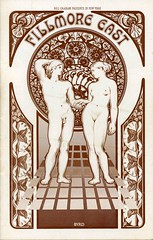
Music Stash Recalls When Rock Was YoungI made quick trip to Wolfgang's Vault. I looked at some of the vintage items for sale and listen to streaming music from the Vault Radio. It brought back quite a few memories. I did not get to New York or San Francisco many times in those days. But when I did I found time to attend several of Wolfgang's productions. They were special enough that I kept souvenirs. Those programs, post cards and hand bills illustrating this post are mine. Mr. Sagan seems to think they are worth almost two grand.
By ETHAN SMITH
Staff Reporter of THE WALL STREET JOURNAL
Two and a half years ago, a Minneapolis entrepreneur named Bill Sagan spent more than $5 million to buy a treasure trove of rock 'n' roll memorabilia: millions of T-shirts, posters, handbills, photographs, concert tickets and other items from the archives of Bill Graham Presents, the legendary San Francisco rock promoter that virtually invented the modern concert business in the mid 1960s.
But what neither Mr. Sagan nor the seller, Clear Channel Communications Inc., realized at the time was that the archives contained an even more valuable bonus: more than 5,000 live audio and video recordings made between 1966 and 1999, featuring artists varying from the Doors to Nirvana. The recordings were made at rock concerts that the late Mr. Graham ran or promoted. They were uncataloged and collecting dust when Mr. Sagan acquired the archive.
Today, the 55-year-old Mr. Sagan controls what may be the most important collection of rock memorabilia and recordings ever assembled in one business. Called Wolfgang's Vault - from Mr. Graham's given name, Wolfgang Grajonca - the company has a staff of 14, projected sales this year of $3 million, and nearly 20 million separate items in its San Francisco warehouse.
Having set up a business selling vintage rock T-shirts and concert posters on the Web, Mr. Sagan is only now turning his attention to the audio and video assets, where he faces a tremendous challenge. He is in the early stages of complex negotiations with artists, their representatives and record labels over the rights to sell the recordings on discs and as downloads. In the meantime, Mr. Sagan plans to begin "streaming" some of these recordings as Internet radio feeds on his company's Web site, which involves little more than paying royalties to organizations that represent songwriters.
The performances, many of which are professionally recorded and extremely high quality, amount to a sweeping, unheard history of rock during its seminal years and beyond. The archives include performances by artists including Bob Dylan, Bob Marley, Pink Floyd, the Who, Tom Petty, Stevie Wonder, the Mahavishnu Orchestra, Emmylou Harris, Aretha Franklin and Tracy Chapman, all of whom played shows put on by Mr. Graham. The are videotapes of early performances by Crosby Stills Nash & Young and from 1978, the Sex Pistols' last show for nearly 20 years, before their reunion in 1996.
Though some of the recordings have leaked as bootlegs over the years, they contain some revealing moments that may surprise fans. For example, a recording taken from Led Zeppelin's first U.S. tour, in 1969 - when the band was opening for Country Joe & the Fish - finds lead singer Robert Plant displaying little of the rock-god swagger that would eventually become his trademark. Instead, he makes nervous small talk to the audience as guitarist Jimmy Page changes a broken string.
"I don't know if [Mr. Sagan] really knew exactly how much rich material he had," says Bill Thompson, the longtime manager of Jefferson Airplane and Jefferson Starship, which played Bill Graham events frequently during the heyday of the San Francisco rock scene in the late 1960s and early 1970s. "This is a goldmine."
Mr. Graham's company mounted more than 35,000 concerts world-wide between its inception in 1966 and its sale, earlier this decade, to Clear Channel, which bought up a number of regional concert promoters during that era. Mr. Sagan bought the archive from Clear Channel, which had little interest in sifting through the thousands of items that were jammed into the company's warehouse.
Mr. Sagan and his staff spent their first six months in business doing nothing but organizing and cataloging the vast collection, much of which had been thrown haphazardly in cardboard boxes, and some of which had been damaged in a warehouse fire.
Today, on WolfgangsVault.com, shoppers can find individual tickets to the Yardbirds' July 25, 1967, show at the Fillmore West for $51 each (a $48 markup over the face value). Prints of photographer Joe Sia's blurred shot of a police officer arresting Jim Morrison on stage in New Haven, Conn., go for $550 to $750. Even the Rat Pack gets the collectible treatment: A black faux-tuxedo T-shirt commemorating a 1988 concert starring Frank Sinatra, Dean Martin and Sammy Davis Jr., costs $82.
But the music and video recordings are the most intriguing and commercially promising. Mr. Graham's company made the recordings partly for posterity's sake, and, in some cases, for a more base motive: adjacent to the Fillmore West was a restaurant owned by Mr. Graham. Rather than lose customers when concerts started next door, Mr. Graham installed a closed-circuit video system that let diners watch the show live - and also captured it on videotape.
When, or even if, the general public will ever hear or see many of these recordings is unclear, however.
The recordings were made legally; Mr. Sagan has a filing cabinet filled with documentation to prove it. But selling them will require various permissions and revenue-sharing deals - not only with the artists themselves, but often, too, with whatever record label they were signed to at the time of the show, or its corporate successor. In the case of dead performers, permission is required from their families or other heirs.
Mr. Sagan's employees have already digitized more than 1,000 audio recordings and sent them to engineers to have the sound quality cleaned up. Now they are in the process of seeking clearances to release the music. Mr. Sagan says he is in active discussions with two major record labels, and believes he is close to a deal for at least some music with one of them, although he declines to name either.
"Is it easy?" he asks. "No. But in some cases they're excited as hell they might be able to make some money of old bands."
Even with clearances, much of the material in the archives is simply not up to snuff for commercial release. "I don't think a large percentage of it will end up on CD, or in any monetized form," says Gavin Haag, who oversees the company's music-licensing efforts. For instance, he adds, there may never be an appetite for dozens of separate concerts by acts like Eddie Money.
Mr. Thompson, the Jefferson Airplane manager, says he is in "early discussions" with Wolfgang's Vault and Sony BMG Music Entertainment to sell the dozens of live recordings made of his clients at Mr. Graham's various venues. Sony BMG, a joint venture of Sony Corp. and Bertelsmann AG, controls the rights to distribute the band's recordings. Sony BMG and Wolfgang's Vault declined to comment on the continuing licensing negotiations.
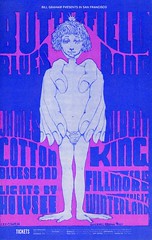
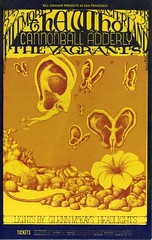
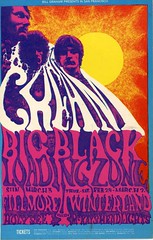
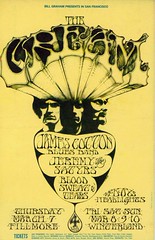
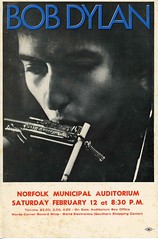
Isn't life interesting?
Oh, and I have one small poster he does not have. It is to the right. It is not for sale.
Where is that key to the safety deposit box?
Friday, February 03, 2006
NRPS
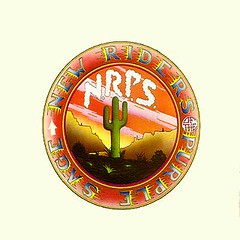 Saturday night before last, in between trips to Virginia to assist with mother's various visits to the hospital, I spent the evening with the NRPS, the New Riders of the Purple Sage, the premier psychedelic cowboy band. It was a nice break, which I needed.
I heard the band this time at my favorite Charlotte venue, the Neighborhood Theatre. Last time it was Saturday afternoon, April 24th, 1971. They opened the music for Joe College Weekend at Duke University, playing on a low stage in the middle of the football field. I had drived down from Virginia were I was in my second year teaching junior high school. NRPS was following by The Grateful Dead, The Paul Butterfield Blues Band, The Beach Boys, and sometime past 11:00 PM, Mountain. I was there for it all, sitting in the grass on the first row. This was about the time of the release their first album, long before Panama Red came to town. Of course last week's version of the New Riders has almost a completely new lineup.
NRPS started as a coffeehouse side project of Jerry Garcia and a buddy, John (Marmaduke) Dawson. Jerry wanted to learn peddle steel and John wrote many of the songs they first played. Jerry and John recruited other musicians as the spirit moved and started to pick up a following. They were soon joined by David Nelson, who once was considered a GD replacement for the very young - and a times struggling - Bob Wier. The trio formed the core of the NRPS and soon they were opening for the Dead.
As Jerry's side project began to cut into his main gig, Buddy Cage, an experienced peddle steel player was brought in. Dave Torbert claimed the bass spot from first Robert Hunter and then Phil Lesh. Spencer Dryden from the Jefferson Airplane took over the drum kit from Mickey Hart. The group's biggest hit, Panama Red, came in 1973. The lineup has been changing ever since.
Nelson and Cage anchor the band today. Nelson has moved to Mexico but he has played off and on as his heath has permitted. Jerry, Spencer, and Dave are, well, someplace else. But that Saturday night their music remained strong.
Monday, January 30, 2006
A Scene From the 'Hood
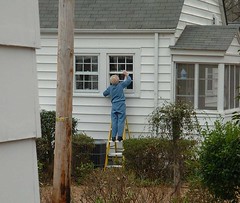 Today has been unusually mild for this time of year. And I have been unusually uninspired on the blogging front; that is until a few minutes ago when I saw my neighbor, who will be 93 this summer, on a ladder washing her kitchen windows. I just had to take a picture. But before I could get my camera she had vanished inside to clean the other side of the glass. So I waited.
I know what you are thinking. I should have rushed over to help. But I already know what she would say. I have been through this before. She will not let someone do anything for her unless she absolutely cannot do it for herself, and she seems to get mildly annoyed if you suggest she should not be doing something, like standing on a ladder. Last time she spent hours trying to change a ceiling light bulb before she called me. A couple of years ago she locked herself out of the house; so she used her ladder to crawl through an open window. I am not making this up.
Soon she was back on the ladder, however the photo from inside the house did not turn out. But by the time I snuck around the corner, she was gone again. She was moving faster than I was.
I don't know what - if anything -I'll be doing when I am 92 and a half. Windows will do.
Finally, always the perfectionist, she was back for a third time. I got her!
I'm glad she does not have a computer. I know she would be annoyed with me showing a picture of her in her housework clothes. I don't like having one of my heroes annoyed with me.
Friday, January 20, 2006
Waste Not
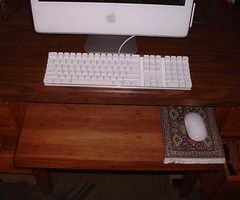 I have a "new" desk keyboard tray. It tells a story.
My father was born and raised on a farm. Like most farms in those days, cash money was scarce. Folks made do. If something broke, they fixed it. If it could not be fixed it was set aside to become part of something else. Dad worked his way through engineering school during the Depression. While his career took him away from the farm, the farm never left him.
On our 2 acre farmette I grew up watching my father recreate features of the life he knew so well. We had a large garden and a small orchard. We raised chickens and, for a time, hogs. We had two garages, a workshop and tool sheds. If something broke, he fixed it. If it could not be fixed dad set it aside to wait for a new purpose to present itself. I watched as dad built - among many other things - a 19-foot boat, single channel TV antennas, solid walnut furniture, and a large addition to our house. A trifling child, usually I best helped by staying out of his way. When it was my time to leave for college I am sure both of us had no idea how much I had been absorbing.
After my father died my mother married another electrical engineer with some youthful farm years of his own. He figured out dad's one-of-a-kind projects around the house in short order and kept them going for over twenty years. His attitude towards things broken was about the same as my father's. When my step-father passed away last year I decided it was time to clean over fifty years of accumulated bit and pieces - what most people would call junk - out one of the tool sheds. It was there I saw a wood veneer top from a long discarded dishwasher. One or the other of them had decided to keep it for some future use. It was then I remembered my father's office desk.
My father helped start a small rural telephone cooperative in the 1950's. He served as manager for over two decades. It was a shoestring operation in those days. Dad, determined to make ends meet, bought a black US Government surplus desk and refinished it. It served two decades as his desk and two decades more after he died. Destined for the landfill several years ago it was rescued by the man who replaced dad as manager. He was kind enough to give it to me.
Dad's old desk is still solid. Made from oak and put together to last several lifetimes, it is heavy, very heavy. It was several years before I even tried to move it into my house. But move it finally I did. However, as useful an office desk it is, it was not designed for computers. With the keyboard placed on the desktop, it is an ergonomic mess. At least it was until I saw that dishwasher top. It was just the right size to replace the center drawer.
I refinished the top, bought some rollers at Lowe's that - after a bit of custom work with a hacksaw and drill - provided support, and slid in my new keyboard tray. It works great, is just the right height, and almost looks like it has been there all along.
I would like to think somewhere two old engineers are smiling. One would be amazed.
See dad, I really was paying attention.
Subscribe to:
Posts (Atom)