Tuesday, June 05, 2007

Number 24

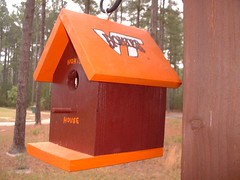
Wildlife-Lane.jpgI counted up the other day. Since I under-graduated from Tech in '69 this is my 24th residence.

I'll save you doing the math; that is a change of address every 1.5833 years. Even allowing for some clusters associated with trips to graduate school in the 70's and then the 80's, and a couple of short moves, I seem to have been a rolling stone. One might think I planned it that way, but no. The moves all made sense at the time, jobs/careers; looking back I'm not too sure. I left behind some great places, some great friends.

Carole King sang in 1971:
So far away
Doesn't anybody stay in one place anymore
It would be so fine to see your face at my door
Doesn't help to know you're just time away
I actually heard her sing that live that year. She opened for James Taylor at Dorton Arena in Raleigh. That was just after the week he was on the cover of Time. Tapestry was just being released. We were listening to what would become one of the largest selling albums of all time, remaining on the charts for six years. Rolling Stone still ranks it #36 of the 500 Greatest of All Time. Restlessly waiting for James, we had no clue. And I had no idea how my life would come to reflect her lament, or that I would be the one moving.

Anyway, # 24 is nice. I really like having a golf course in the backyard. Even though moving is kicking my butt, I am glad to be here. I hope to stay for a while and raise that average.

I thought you all might be interested in what has taken so much of my time and energy lately. The photo was taken in the winter; it looks a bit nicer today with the new landscaping. Other changes to follow; those green doors have got to go.

Saturday, May 19, 2007

The Brent's Iron Gate

Brent-Iron-GateWhen my mother remarried over twenty years ago Harper Brent, my step-father, retired, sold his house in New Jersey, and moved to Virginia to our family home. Among the things he brought with him was a heavy iron gate he and Jean, his first wife, used for access to their backyard. Its "french" design must have reminded him of her. He found no use for it and it remained stored until recently in an outbuilding, our old chicken house.

Now that mother and Harper have both passed away my sister and I have responsibility for their stuff, including iron gates. We tried to give it away to Harper's sister or one of her daughters. No takers. I suggested my sister take it. She just gave me that familiar look as if I was out-of-my-mind and declined.

With our new backyard needing a fence and fences needing gates, yesterday I gave it a new home.

If there is a heaven they surely have internet by now, high-speed I am sure. So just in case: johnharperbrent1919@heaven.org. We finally put that gate to use. I hope you and Jean don't mind where it ended up. We will brush off the rust and paint it soon. Promise.

Monday, April 23, 2007

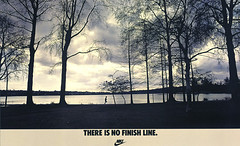
Nike FinishLineBack about 24 years ago when I was a grad student at Tech I saw a poster at a running store that seemed to capture grad school life. I talked them out of it.

I still have it, foamcore mounted, plastic wrapped, corners damaged, but in generally good shape. Today seems to capture my last few months. No finish line, but all is well.

As I was looking for a copy of the poster to use in this blog I learned the photo was taken by John Terence Turner, an acclaimed commercial photographer. The poster is now consider iconic.

Thursday, April 19, 2007

Virginia Tech

imagesI first saw Blacksburg, and what was then V.P.I., almost fifty years ago, the summer of 1960. A member of my high school's chapter of the Future Farmers of America, I was attending the FFA's Virginia state convention - a wide-eyed rising 9th grader. About 5 foot six, I weighed little more than a large sack of chicken feed. I was a member of our school's second-string crop judging team; we did surprisingly well.

Blacksburg was the "sleepy little college town" in the mountains then, home to a small agricultural and mechanical/military school and little else. You could count the traffic lights and have fingers left over. V.P.I. was essentially all-male and all-white; being a member of the corps of cadets was the norm. Foreign students and women on campus were not. The student body generally came from rural and small-town Virginia, where it was highly regarded. A turkey was the school mascot. It was so not UVA, William and Mary, or Hollins. It was not even V.M.I.

Things change and stuff happens. By the time I graduated from high school V.P.I. was beginning its remarkable transformation into a major university. My lackluster high school record and vague aspirations did not make me highly sought after college material. But V.P.I. took a chance and accepted me. They had probably seen worse. After purgatory at their Danville Branch I finally arrived in Blacksburg in the fall of 1966.

Evidence of the major commitment to transform Tech was everywhere: new buildings, overflowing dorms, expanding academic programs, a much larger and more diverse student body (though still not enough girls), and a major emphasis on athletics, mainly football. We even managed a traffic jam on some Saturday afternoons in the fall. Off-campus housing grew, a fine off-campus book store opened, along with a decent restaurant or two. Long hair and an underground newspaper appeared. The 60's arrived at Tech and Blacksburg sometime in the 70's, but it arrived.

I should have been happy at Tech and Blacksburg, but I was not. Blacksburg seemed like the end of the earth. I called it Bleaksburg, a reference to more than its weather three seasons of the year. Driving into town one Sunday I nearly ran off the road laughing at a road sign where someone had written "armpit of the nation" under the word Blacksburg.

The school's administrators - many holdover's from its days as a military school - seemed to be truly hostile to students. Their martial vision of what college life should be was not my vision. It was a conservative campus and I was, without much self consciousness, becoming quite liberal, at least by Virginia standards. I began to enjoy walking on their grass.

My first fall on campus saw the football team invited to what I believe was its first bowl game, the Liberty Bowl in Memphis. We were to play the University of Miami. I remember walking across campus one cold, cold night headed downtown for some food (I hated the food at Shanks) and seeing a student-made sign hanging in the wind. "Beat Miami" it said. Blacksburg, Miami. Blacksburg, Miami. Hunkered into the wind I had a hard time wrapping my mind around any idea that contained those words together. Yes, true to my school, I did drive what seemed like halfway across America in my Corvair to attend that game. But I wanted out.

That would not be easy. I had just changed majors, from engineering to political science. PoliSci allowed the most electives at Tech and this would give me the chance to pretend I was at a liberal arts college where, by that time, I discovered I wanted to be. My academic record at that point was not much better than my high school record, making a transfer problematic. And there was a war on and a military draft, not something to be taken lightly. I needed that 2-s deferment. And I doubt I could have convinced my parents that it was a good idea to transfer. After all they were paying for my little adventure in academia.

My salvation came from an unlikely series of events. That January a friend at UVA invited me to Charlottesville for a week-end. He said he would get us some dates from Mary Washington College and we would have a great time; might get lucky. I was all for a great time and good luck, so plans were made. That Friday came and with it a snow storm. I said what-the-hell and made for Charlottesville. The weather worsened and I was lucky to make it to campus. The train from Fredericksburg was canceled, as were the events of the week-end. What to do? He had a friend who had just returned from a semester aboard a ship that had sailed around the world. We went to see him. Still very much overwhelmed by the experience, he told stories for hours. When we left he gave us literature about the college program and said we should apply as soon as possible. Sounded good to me.

Fast forward and I returned from that Semester at Sea with a larger view of myself, my world, and Blacksburg. Virginia Tech would continue to annoy me from time to time as it seemed slow closing the gap between what I wanted of it and what it could deliver. But I finally had matured enough to begin to take advantage of what it did offer, and to appreciate that wonderful place in the Virginia mountains, Blacksburg.

I now have two degrees from Tech, having returned in the '80s for a Master's in Urban and Regional Planning. My wife also has two degrees from Tech. She grew up just outside Blacksburg. Her sister in-law works in Norris Hall, second floor. I have wonderful friends in Blacksburg who worked for Tech for many years. Even though I also have a degree from UVA and have great respect for the University, I am a Hokie. I have marveled at Tech's growth, been amazed at the transformation of Blacksburg into a world-class small city. So watching the news over the past few days has been hard.

The violent death and injury of so many students and faculty at the hands of a psychopath renders words inadequate to convey the horror. One cannot look into the faces of horrified students and anxious or grieving parents without becoming one of them. Trying to make sense of it all seems overwhelming. And yet that is what each of us will try to do, needs to do. The young man with two handguns shot at us all.

As tragic as the events of last Monday morning were we have the ability to make them worse. And we will. I could feel it as I was watching the first reports on CNN. Even as the news was happening I could feel the ramp up to what was coming: the second guessing, criticizing, the self-righteous placing of blame, the spin in service to political agenda. Even before we had time to learn the fate of friends and family, grieve, or learn the name or fate of the gunman, the process was well underway.

Our TV hosts struggled to learn just where Blacksburg was and fumbled about trying to describe a university they knew little about. Tech was both a major university with 26,000 students and "insular" according to Brian Williams, who also placed it in the Smoky Mountains. While we were all trying to reconcile the image of a peaceful, semi-rural college environment with violence we usually associate with our urban areas or foreign theaters of war, the talking heads moved from conveying what little they knew about the horror unfolding on campus to asking leading questions and poking around trying to find an angle. They think they are reporters.

It bled and it led for hours on end. After asking students what they saw or heard Wolf Blitzer and the other CNN reporters (I use the term loosely) made a point of asking if they still felt safe, if they blamed the University and if the were planning to transfer. It took a while before they stopped seeming surprised when the students usually said they loved their school, the community, and had not considered leaving. I thought generally the students interviewed sounded much more thoughtful than their hosts. And without the "like, you know what I'm saying." I was proud of them.

Once it appeared that the gunman was dead and there was a two hour gap in the shootings the focus shifted to finding a way to question the University's handling of the situation. Well before any of the details were to fill out the timeline our TV hosts were pouncing, safely behind the camera miles away from danger or responsibility past filling commercial-safe airtime. Without possibly having the facts with which to assess situation they began to invite questions of competency of local law enforcement and the judgment of school administrators. When will we come to understand that when someone prefaces a statement, "I don't understand why ___", they really don't. You are being set up.

Soon "experts" with little or no knowledge of the specifics began to appear and try to shape our view of the tragedy. Dr. Phil appeared early. We eventually heard from Ted Nugent (FOX?) who said this would not have happened if students were allowed to legally carry guns on campus. He did not mention bows and arrows. Can they work in Springer next? If we were not dealing with a real human tragedy, real suffering and loss, this would almost be funny. It is not funny.

Once we learned the gunman was a student and was born in South Korea the press was perplexed. Even though he had lived in the US most of his life - since he was 8 years old - he was Korean. Since South Korea is an ally of the United States it has been difficult for the press to figure out how significant that was or how to play it. Now if he had been from the Middle East...

Few bothered to remark that the killer was a young man and that young men are have almost exclusive ownership of this type of serial murder. You assumed the killer was male, didn't you? I did. I didn't expect the male-dominated media to go there and they didn't.

We now know he was recognized as a loner and "troubled," and had come to the attention of the school as such. He had received at least some attention from mental health and law enforcement professionals. The NYTimes gave us this morning, "Officials Knew Troubled State of Killer in ’05." Well he was not a killer in '05. He was just a student with problems, probably not that unlike any number of other students on campuses from coast to coast. The headline whispers that the "officials" are now partially responsible for the crime. I am sure that these professionals wish now they could have seen into the future and done something. But I doubt even Cho Seung-hui could have done that in '05.

Being "troubled" and dead brings us to the possibility that the tragedy includes Mr. Cho. While I am sure many would recoil at this so soon, the compassion and forgiveness that my Christian countrymen so often trot out as a model for others, might not be misplaced for this very mentally ill young man and provoke wonder how he became so bitter and twisted. No, it is much easier and entertaining to now find fault with the living, those doing their very best to ensure safety of others when that still, unfortunately, was not sufficient.

Yes, I am sure campus police and other university officials wish they had done some things differently Monday morning. Given the contents of the package Mr. Cho sent to NBC that morning between shootings it is certainly possible only the location, names and number of future victims would have changed. What is likely however is that the number Mr. Cho's victims will continue to grow as some try to use the tragedy for their own ends.

Regarding making sense of it all, once again our dim-bulb President got it wrong. He said on campus trying to mean well,
It's impossible to make sense of such violence and suffering. Those whose lives were taken did nothing to deserve their fate. They were simply in the wrong place at the wrong time. Now they're gone - and they leave behind grieving families, and grieving classmates, and a grieving nation.
Well, George, making sense of things is what what people at Universities try to do, and with some success. The question is what sense we will make of it. Don't try to suggest impossibilities at a place based on possibilities. And they were not in the "wrong place at the wrong time." A convenient cliche, but again off the mark. They were in the right place, Blacksburg, Virginia Tech.

Go Hokies.

Thursday, April 05, 2007

Pollen Teaser

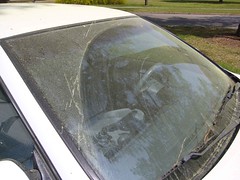
OK. After that overwhelming show of support for this blog - but before I start unloading in a major way - I will share what Mother Nature shares with all of us around here for a week or 10 days each spring, pollen.Pollen

I have never lived in a place where the pollen accumulates so. This year it seemed especially bountiful; it was everywhere. I am so glad I do not have an allergy to this stuff.

Neither photo really captures the messiness of it all. Local youth groups make a killing on Saturday car washes; washes like my car didn't get.Pollen2

Plant sex going on all around us. I'm surprised someone in the legislature of this Red state has not introduced a bill to shield us from this filth, especially the youth at those car washes.

I will explain the location of the second photo - pollen pooling after a rain - in my next blog. Just after I finish moving in.

Tuesday, March 20, 2007

I'm Back!

SpringWell, probably. We'll see.

It has been six months since my mother died. Since then I have blogged only twice, once a tribute to her and a few weeks later about my discovery of a photo confirming a long held but questioned memory. Since then I just have not felt like it.

It would be convenient to say that I have been busy, too busy to do this blog justice. True. I have been VERY, VERY busy. It would also be logical to assume that mother's death affected me, launched me into one or another of those stages of grief one reads about in self-help books. And that would be true also. But that is not the entire story.

Mother lived a long and blessed life. She died at home, as she wished, well looked after. She was in no pain and suffered about as little discomfort as is possible for an 87 year-old in declining health. She was frequently visited by her family; she knew she was loved. She was the last of her generation in my family. Her death was sad, not bad. I was determined to remember that.

But her funeral was for me the latest of about a dozen I had attended over the past three years. I had taken to keeping funeral clothes in the trunk of my car. The cumulative weight of these occasions finally just wore me down. So I have been becalmed with my thoughts turned inward, reluctant to share my thoughts about darkness and light. My generation are now the grown ups. The elders have gone; long live the elders.

We elders have responsibilities. Among those is reminding those around us - friends, family, and the odd stranger stumbling across a blog - how wonderful life truly is. And as Warren Zevon once advised, we should "enjoy every sandwich." It is spring tomorrow and it is time for me to take up those responsibilities.

Watch out!

Saturday, October 21, 2006

Memory Intact, Thank You Very Much

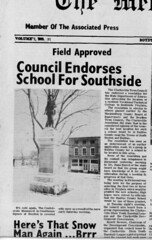
StatueSeveral years ago I was talking with someone about the county I lived in as a youth. I mentioned the possible implications of the orientation of the statue of the Confederate soldier in front of our local courthouse; it faced the courthouse with its back towards the rest of the world.

To illustrate we drove by the courthouse where - much to my chagrin - it was observed with its back towards the courthouse and facing outward as all other such statues I have seen. It remains so to this day.

While on business at the courthouse several times over the past couple of years I tried to find someone who remembered - or had heard tell - of the statue so turned. No one did. I was beginning to question my memory until last week when I chanced upon this county newspaper from 1965. There on the front page was a photo of the statue turned as I remembered it, with its back to the street, facing the courthouse steps. I feel better now.

Want to hear my commentary about how the orientation of a statue erected in 1908 - 43 years after the war it commemorated - might speak volumes about the attitude of a rural Virginia county towards the rest of the world? How about how the turning of the statue 180 degrees might (or might not) signal that times are slowing changing back home?

Thursday, September 28, 2006

Eyleen

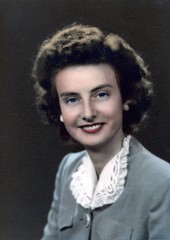
EyleenLast week my mother, Orrie Eyleen Gill Edwards Brent, gently passed away at home. She was 87. She never liked her given first name, so she never used it. She was a bit spunky; she was Eyleen.

My sister and I were looking for a photo of her for her obituary and ran across this one. We had never seen it before but thought it perfect.

An obit can be found at the Richmond Times-Dispatch or here.

Below is a slightly improved version of the eulogy I managed to get through last Sunday.
Almost 60 years ago our family moved to Chase City. We did not know anyone; we had no relatives closer than Richmond. We were dreaded "come here's." But the people here - and especially in this church - embraced our family and Chase City became our home. We thank you.

After our father died, which was 25 years ago but seems sometimes like the-day-before-yesterday, Chase City welcomed our new step-father John Harper Brent. Some of you know that he was mother's high school sweetheart before she met our father. You welcomed him also, making their years together here truly Golden. We thank you.

Over the past year we were blessed to have wonderful ladies who looked after mother as her health declined. They entered our home as employees; they left as family. We thank you.

Most of us embody a set of contradictions. These contradictions are often the foundation of personality. Some of mother's contradictions you may know... and others you may not.

Mother's first priority was always her family. She did her best to spoil her children & grandchildren, with some success I might add. But while her family knew her as a sweet, loving mother and grandmother, we now understand that she had a secret life after we left home - a substitute teacher in the public schools. At least some of her students remember her to this day as Sergeant Edwards. Others have described her as "tough but fair." She would have liked that.

My sister and I never needed to subscribe to the local paper to learn what was going on in town. We had our mother. Mother was our connection to the Chase City Grapevine. I am sure you have heard of it. You may be part of it. But as much as she valued her role passing on the local news, when her hearing began to fail she refused to wear her hearing aid. We know how much she enjoyed conversation and her participation in the "talk of the town." Why she didn't want to use her hearing aid remains a contradiction - a mystery - to us.

Hair. Our mother seemed to have an abiding interest in hair. She was always getting her hair "done" or "fixed." I never had the courage to ask what that really meant. But it seemed to make her happy. Back in the 1960's she developed an interest in my hair, specifically its length. That interest continued into the 1970's. And the 80's. And the 90's. I have fond memories on my visits home of her trailing around behind me with scissors, just to give me a little trim.

Once you got her out of the house, mother loved to travel. She and Harper instilled the love of foreign places in my daughter, for which I am truly grateful. But mother's best trips were those that brought her back home. Malindi learned that lesson also.

Mother collected cookbooks and read them like novels. She warned my sister and me of dire consequences if her collection were to ever end up in a yard sale. And we believe her. She occasionally tried new recipes. But no matter how much they were praised we never saw them again. Like many good restaurants, and some not-so-good, mother had a menu that seldom changed. I still dream of lime congealed salad, with mixed fruit.

For some reason mother married not one but two electrical engineers. Dad graduated from UVA and Harper from Virginia Tech, both in 1940. It is good that mother was not much of a sports fan. She must have influenced my sister more than she knew. Sue married a Virginia Tech engineer, class of 1973.

Mother was a child of the depression and the privations of World War Two. She squeezed every dime and seems to have never thrown anything away. If you would open any closet in our house, look under any bed, or visit our basement you would understand. Our father and Harper were the same way. But unlike them mother was also a World-Class Shopper. Our father would talk of driving mother to Heaven - his term for Miller & Rhodes and Thalheimers. Mother's prize possessions then were her charge plates - for those who don't remember, the forerunner of credit cards. And how many people do you know that could recite their Sears credit card number by heart?

Shopper she was, she enjoyed most shopping for others. If there was one trait she had that I will always remember it was her desire to do for others. She seemed especially concerned that we were all well fed, very well-fed. And after the blood thinner she was taking often made her feel cold, she was concerned that those around her were cold also.

My sister remembers the time last winter when mother was in the hospital quite ill, flat on her back and hooked up to all sorts of machines. She asked Sue, "What can I get you?"

My nephew Kevin and his wife Heather remember the last time they saw Mother. She asked if they had eaten breakfast.

I remember the last thing Mother said to me two weeks ago. As she was being helped to bed she stopped to ask if I was OK. Knowing she would not hear, I just nodded, smiled, and gave her a thumbs-up sign.

So mother, this is for you. (Thumbs up)

Monday, September 18, 2006

Aunt Jean

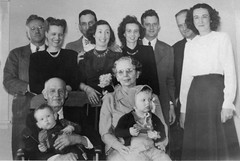
Edwardses1947Jean McCallen Edwards, my aunt by marriage to my father's brother Pickett, died last week. She was 93. Pickett passed away this June. Wednesday I will help carry her to rest beside him. Jean was a remarkable woman, worthy of more than a short blog post. If you are interested here is a link to a more complete obit.

I remember the outsider from up north who fit in with the Edwardses of Cohoke better than she knew. I remember the active, optimistic woman who was always fun to be around. I remember her toleration and amusement at my childhood misadventures when my parents reacted (as befitted their role) with sterner stuff. She and Pickett formed a solid cornerstone to my extended family. They were good people who were fortunate to live long, good lives. I will not let myself feel sad when I think of them. But I'll be damned if I won't miss them.

In the photo, taken I believe Christmas 1947 at Riverview, Jean is standing behind my grandmother's right shoulder, next to my mother. I am the little bugger on my grandfather's (the Bossman) lap, as ever just a few degrees short of vertical. Aunt Sallie, my father's only sister, and her husband Charlie are on the far left. That's Sallie's son, Cousin Bill, on grandmother's lap. Uncle Winston, daddy's oldest brother and wife Zady are on the right. Pickett is peeking out behind Jean; my father smiles beside mother.

What I would give now for a few hours of conversation with each of them, as I recently had for the first time in about 50 years with Cousin Bill. Time, it seems, is really about all we have.

Thursday, September 14, 2006

Have You Had Enough?

RLJsilkscreenI received this email today, thought I would pass it on...
Rickie Lee and two members of the Squirrel Nut Zippers (Tom Maxwell and Ken Mosher) have written a witty, incisive and extremely relevant song called "Have You Had Enough?", in response to these troubled times. Addressing the crookedness of the Bush Administration, and the tremendous and lasting damage they have wrought on our civil liberties, our environment, our foreign relations, our quality of life and on and on, "Have You Had Enough?" is a song that means a great deal to Rickie and is one that she wants to share with anyone who it speaks to.

To that end, this song is available for FREE, downloadable from Rickie's MySpace page. Please feel free to share it with everyone and anyone you know...

Saturday, September 09, 2006

Jane & Fang

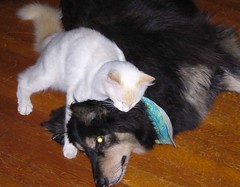
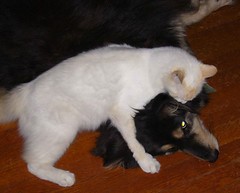
Fang & Jane2Our dog and cat get along well. They both seem to realise that the other belongs in the household too. Aside for becoming a bit snippy when one shows interest in the other's food, they seem to enjoy each other's company.

Fang & Jane1But I am still a bit stranged out when Jane lays on the floor and lets Fang lick the inside of her ears. Sometimes Fang will be laying on her face. And Jane just lies there. Maybe they should get a room.

Wednesday, August 23, 2006

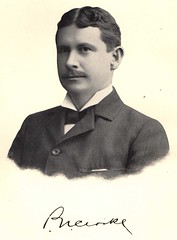
Peyton Neale Clarke, A Biography

I seem to have been busy doing everthing but blogging. One of my recent projects was writing a biography of Peyton Neale Clarke, the author of the book at the center of the book I am writing. On the off-chance that someone else may be interested in Clarke and/or has some addition information about him they would be willing to share, I am posting this biography.

Peyton Neale Clarke - A Biography

In 1897 John P. Morton and Company of Louisville Kentucky published a brown leather-bound volume by Peyton Neale Clarke, a local forty-two year-old stockbroker, titled Old King William Homes and Families - An Account of Some of the Old Homesteads and Families of King William County, Virginia From Its Earliest Settlement. Since reproduced several times in both print and electronic format, almost half of its pages are devoted to only one of these families, the Edwardses. The book includes stories about Edwards family members and an extensive, detailed genealogy reaching back over a century and a half which has been highly prized by our family.Clarke's book

The author seems never to have lived in the county. However it is evident that he was well acquainted with King William through his mother, Judith Browne Claiborne Neale. She was the daughter of James Hill Neale and Judith Edwards, of two well-established local families. Judith Edwards was the only daughter of Butler Edwards, the fifth son of the Ambrose Edwards who figures prominently in Clarke’s book. But Clarke wrote that his mother was not named for his grandmother Judith Edwards but "for the wife of her uncle, William Hill, who married Judith Browne Claiborne of ‘Elsing Green’ ... a warm friend of her mother's..."

Clarke continued that Judith Neale moved to Richmond from King William County about 1840 - when she was 18 - marrying John David Clarke sometime thereafter. Peyton was close to his mother, recording in his book that she “spent the last years of her earnest Christian life in Louisville, Kentucky, where she died October 19, 1895, and is buried in ‘Cave Hill Cemetery,’ at Louisville.” As Clarke also reported that none of his mother’s other children were living in Louisville in 1897, it is likely she was living with him and his family at the time of her death. Clarke dedicated Old King William Homes and Families to her, a dedication missing from the reprints.

Clarke's fraternal grandfather, Andrew Clarke, was born in Edinborough,2 Scotland in 1782. He moved to Virginia about 1800 and married Mary Freeman. Thus a Freeman family history appeared in his book despite having no direct connection to King William County. Andrew and Mary had two children: John David Clarke and Sarah Bruce Clarke, who Clarke reported to have died "before she was twenty years of age."

The 1840 U.S. census shows Andrew Clarke in Richmond as head of a family comprised of one male between 50 and 60 and two females, one between 40 and 50 and the other - presumably Sarah - between 15 and 20. The 1850 census lists Andrew and Mary Clarke in a two-person household. He is 67 and she 60. He is listed as a grocer. Clarke wrote that his grandmother Mary, who "had a narrow escape at the burning of the Old Richmond Theatre in 1811," died November 5, 1851. Clarke added that his grandfather, "a plain and honorable man who lived a quiet, unostentatious life," died February 10, 1860. Both grandparents were buried at Richmond's Shockoe Hill Cemetery.Clarke, PN

Of Peyton's father, John David Clarke, less is known. Oddly Clarke did not provide vital information for his father, other than he was buried with his parents. The census is a bit more generous. The 1860 census shows John David Clarke's family in Richmond. He is 38 and wife Judith is 37. It appears he was a carpenter. All four children - two boys and two girls - are listed by name and age. Sally B. is 13 and is listed as having attended school within a year. Andrew is 12 and also has been to school. Eva is nine and Peyton, born March 22, 1855, is five. Clarke wrote that he was "Reared amid the turbulent scenes of the war between the States." Certainly that was an understatement.

The 1870 census shows Judith Clarke as head of household, indicating that her husband died during the 1860's. While it is possible that John David Clarke died soldiering in the 1861-65 war, his age and Clarke’s lack of comment in the book makes this unlikely. The census lists eldest son Andrew Neale Clarke as 22, a clerk in a furniture store. Eva Neale Clarke, 19, is "At Home." Peyton, now 15, is listed as an apprentice at a furniture store, possibly working with his brother. Clarke wrote that the oldest child Sallie Belle Clarke at the age of 23 married Captain John James Wright in 1867 and they had moved to Kentucky; she and her husband are missing from this census. The Clarkes seemed to be doing well enough financially to afford two live-in servants, black women, 18 and 36 years of age. However family circumstances would soon change considerably.

Clarke’s sister Eva eloped and married Clinton DePriest on July 7, 1871. She died that August, less than six weeks later. "She was a most lovable and popular young woman, and her romantic marriage and early demise awakened a flood of sympathy from even entire strangers, as the number of poems, newspaper notices, etc., published at the time testify." He provided no clues as the circumstances of her elopement or death. We do not know if her death is connected, but that same month Peyton moved to Kentucky. As he was only 16 it is likely he initially stayed with his sister Sallie and her husband, probably near Louisville.

Clarke wrote that his older brother Andrew later moved to Kentucky, in 1879 when he was 29. An A.N. Clarke - probably Andrew - is listed in the 1880 census as living in a Louisville boarding house. He is described as being born in Virginia, 32, and a clerk in a store. Clarke mentioned in his book 17 years later that his brother was living in Paducah, Kentucky and was “the local manager of the R.G. Dun & Company Mercantile Agency.” Clark also mentions that Andrew had married in 1895, at the age of 47. The 1900 census finds Andrew with wife Katie in a Paducah boarding house. He is 56 and she 36. No children are mentioned. He is listed as a commercial reporter, which describes the business of R.G. Dun and Company. After 1900 no mention of Andrew or Katie has been found in census records.

When Peyton's mother moved to Kentucky is not known. We do know from census records that she was living with her daughter Sallie Wright in Anchorage, Jefferson County, Kentucky - now a suburb of Louisville - in 1880. Oddly, no reference seems to exist in the 1880 census for Peyton Neale Clarke, even though by this time he had married Mary Newman of Louisville and they had a young son.

Mary Newman was the daughter of William Houston Newman and Elizabeth Howard. Like many Kentuckians, the Newmans had Virginia connections, providing Clarke with a reason to include a short Newman family history in his book, again despite having no obvious ties to King William. Like his grandfather Andrew Clarke, Peyton's father-in-law was in the grocery business.

In naming their four children Peyton and Mary followed the tradition of using established family names. William Newman Clarke, born October 9, 1877, was named after Mary's father. Eva Neale Clarke, born April 21, 1883, was named after Peyton's late sister. Sadly this Eva Neale Clarke also died young, a little over two years later, on May 20, 1885. She was buried at local Cave Hill Cemetery near her mother’s relatives. Namesake Peyton Neale Clarke, Jr. was born on April 29, 1888. Sanford Howard Clarke, born January 4, 1896, was named after Mary Newman's brother Sanford Keith Newman3, who had died the year before.Clarke Home 1333 copy

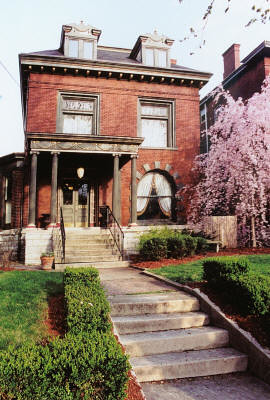
The 1890 census forms for almost the entire U.S., including Kentucky, were burned in a 1921 Washington D.C. fire. However we know from other local records that about 1893 the Clarke family occupied a home at 1431 South 3rd Street, Louisville. It would be renumbered in 1909 as 1333. This would remain the family home for over 40 years. Clarke also mentioned that his sister’s husband, Captain John James Wright, retired about 1890, and they were living in Dresden, Germany at the time the book was published.

The 1900 census finds the entire Clarke family listed at their home for the last time. The eldest son, known as Newman, is 22 and listed as a clerk. Twelve-year old Peyton Jr. is "at school." Sanford is four. They have two single female servants. Rossie Keating (?) is white, 27 years old. The other, Lucy Hamilton, is black and listed as 45. For at least another twenty years she would remain a member of the Clarke household.

Clarke wrote in his book only that he was "engaged in business." However in as early as 1886 Clarke was listed in a city directory as an Assistant Manager at R.G. Dun & Co. - a commercial credit reporting company - at 826 6th Street, Louisville. In 1933 this company merged with the Bradstreet Companies to form Dun & Bradstreet Corporation, or, since 2003, D&B. At some point Clarke left R.G. Dun and formed his own business, P. N. Clarke & Company. This was likely to have occurred before the 1900 census that describes Clarke as a “broker,” not his job title in the city directory nor the primary business of R.G. Dun.

The 1910 census lists Peyton Sr. as a “broker of stocks and bonds.” Peyton Jr.,now 21, is an automobile salesman. This was two years after the Ford Model T was introduced. Fourteen year-old Sanford is still in school. The 1910 census shows that a male servant, coachman Jacob Williams, has been added to the household. He is 28, single, and is listed with a racial designation that looks like "Mu" or mulatto. Rossie has gone, replaced by another young (20) unmarried female servant, Cora Russ (?).

The 1910 census also shows that Newman is now married to Eda Turner. This occurred perhaps as early as 1908 as he is listed in the city directory in 1908-09 as living in the St. James Apartments on St. James Street. By 1910 they are living at 520 Belgravia Court. At census time they have a 2 month-old boy, William T. Clarke.
In Caron’s 1911 Directory for Louisville, P. N. Clarke & Company is listed as occupying rooms 307-316 of the Columbia Building. They are described as “brokers and financial agents.” Joining Peyton Sr. in the directory is his eldest son, Newman. Peyton Jr. is a clerk.

In 1917, as the U.S. entered WW I, Newman and Peyton Jr. registered for the draft. Newman was 40, married, a broker of stocks and bonds now with John L. Dunlap & Co. at 58 Main Street. He and Eda had moved to 1907 3rd Street. Peyton Jr. was 29, single, living with his parents, and was employed by the Louisville Athletic Association as Secretary to the Louisville Baseball Club, likely the Colonels of the minor league American Association.

The 1920 census lists Peyton Sr. as a “financial agent.” Sons Peyton Jr. and Sanford are living at home. Peyton Jr. is listed as 29 but is 32. Sanford is listed correctly as 23; he will be 24 the day after he is enumerated. Both are single, with occupations listed as “none.” A new servant has joined 69 year-old Lucy Hamilton. She is Sally Elizabeth Surding (?), white, 36 and married. Newman, Eda and nine year-old William T. (listed as Turner) are still living at 1907 3rd Street. In 1926 Peyton Sr. found time to write a second book, Digest of Kentucky Tax Laws, published by the Kentucky Tax Reform Association. It was a slim volume, 28 pages.

Finally, in the 1930 census, Peyton Sr. is listed as 75, with no occupation given. Mary is 72. Newman Clarke has returned to live at home. Now 51, divorced, he is listed as a broker of stocks and bonds. No references to his ex-wife and child have been found in this census, the last currently available to the public. Peyton Jr., 42, is listed as a stenographer at City Hall. He remains single. For the first time in 30 years Sanford is not listed as living with his family. In fact, Sanford seems to be missing from the 1930 census altogether. Also missing is Lucy Hamilton. Perhaps reflecting the times, the census shows no “servants” but that they have taken in a border, Lottie Bledsoe, white, 45, and married. She is listed as a housekeeper at a “private house,” probably for the Clarkes.Clarke Graves

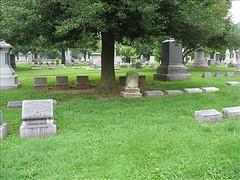
The 1930’s were hard on the nation, and the Clarke family. The depression must have been particularly distressful for financial advisors and stock and bond salesmen. Peyton Sr. was the first to die, March 10, 1936. He was almost 81. He was buried near his mother and daughter Eva. Only seven months later Peyton Jr. joined them. He was 48. Next was Sanford Clarke in March, 1937, only 41. Mary Clarke witnessed this all; she lived two more years, passing away in May, 1939. Like her husband she lived to be 80. Finally Newman passed away in November, 1944. Today they all lie together in Section P, Lot 661, at Cave Hill Cemetery.

After-word:
In 1941 a Miss Ada R. Turner was buried at Cave Hill, but not with the Clarke family. In 1982 William Turner Clarke was also buried at Cave Hill, although with neither the Clarke family, nor Miss Ada. More research is necessary to determine if these were Newman’s ex-wife and son.

Author’s notes:
The sources of most of this biography come from Clarke’s Old King William Homes and Families, and US census records found at Ancestry.com. Additional information was found using various internet sources, especially www.oldlouisville.com, a web site of the Old Louisville National Historic Preservation District. The photo of the Clarke plots at Cave Hill was provided by Gregg Fowler, a former resident of King William County, now living in Louisville.

In looking over what I have been able to learn about Peyton Neale Clarke and his family several questions present themselves: Why did Clarke write so little about his father? Why did Eva Neale Clarke choose to elope and what caused her death? Where was Peyton Clarke and his young family during the 1880 census? What took Captain John James Wright and wife Sallie Belle Clarke to Dresden? What became of Andrew Clarke and his wife Katie? What happened to Newman’s family? Do they have any living descendants? And why did Clarke devote so much space in his book to the Edwards family? Maybe more research will answer these questions.

Wednesday, August 02, 2006

FloydFest 5

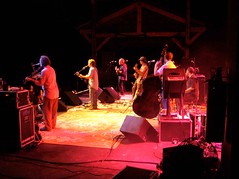
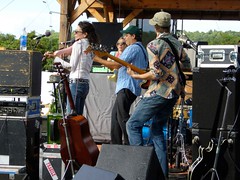
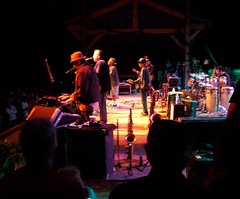
Merged-Crowd2Last week-end was FloydFest 5. This was my third festival, my wife's fourth, and Virginia - my wife's niece - has been to them all. Also camping with us were Virginia's father John (who won the Best Camper Award this year), daughter Rachel, and friend Mike.

RREFloyd06As usual the week-end featured great music - especially from folks I had never heard of - and interesting weather. This year the weather was sunshine and wind. It was almost...hot. Actually it was hot and mostly dry. Quite a change for a festival widely noted for being wet and cool.

The music started on Thursday night this year with Railroad Earth playing to a good sized early crowd. Friday brought an early morning wind gust that took our large community tent down the hill 30 feet, scattering camping gear everywhere and breaking a pole connector. My minimal staking efforts were improved upon as we reestablished base camp. Duct Tape and friendly neighbors to the rescue and we were back better than ever.DonnaFloyd06

The biggest change this year for us were the tickets. Because the tickets we usually buy were sold out we were forced to purchase the more expensive VIP tickets if we were to camp as we had in previous years. But these tickets came with added features we quickly came to enjoy.

As VIPs - an almost humorous title in this neo-hippy egalitarian, if temporary, community - we had backstage passes that allowed us to eat, drink and hang out with the musicians. We also could sit on stage during the performances. Since the food was good and company pleasant, and there was SHADE, what was not to like?JakeFloyd06

Every year I have attended Floydfest I have had moments when I wonder why I was putting up with the obvious annoyances and irritations. I keep telling myself that I am getting to old for this. While the festival is very well organized, the site kept clean and attractive, and the attendees remarkably friendly and well-behaved, the long drive and camping out for three days can be a Challenge. Then, often when I am least expecting it, it all becomes worth it. Usually it is the music - live, fresh, inspiring. Sometimes it is just a seemingly random human act of kindness. It also can be the beautiful Blue Ridge mountains. Occasionally the music, people and setting all come together and the joy is almost overwhelming. My musical highlights...LobosFloyd06

RRE once again justified my devotion. I have heard them eight times now over the past two years. Tim especially seemed on fire Thursday night. Eddie From Ohio was just Too Much Fun; I need to hear them again. The Akoya Afrobeat Ensemble kept everyone rocking and smiling during the only rain shower of the festival. Jake Shimabukuro was just jaw-dropping. Who knew what a ukulele could do? I have never heard Donna the Buffalo play better. And Los Lobos just tore up the crowd Saturday night, justifing my opinion that they have been arguably the best American band over the past 25 years.BestCamper06 Finally, Sunday morning gave me the Campbell Brothers sacred steel in the dance tent. Christian music this side of Bach never sounded as good to my ears. If I had heard a complete difference set of musicians I probably would have been just as satisfied.

Hot, tired, and a bit sunburned we left Sunday about mid-day. Floydfest 6 is just around the corner.

Friday, July 21, 2006

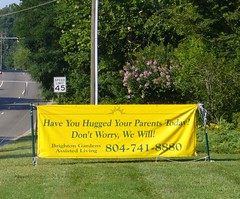
Have You Hugged Your Parents Today? Don't Worry, We Will!

Parent Hug 2Last spring, I think it was about Mother's Day, I was driving to visit my sister and her family. Not far from their home I saw this sign in front of an assisted living facility. It rendered me almost speechless.

While I am sure those who came up with this advertisement thought it would speak well for the care given to their residents, to me it spoke of something very, very wrong.

Months later - I took this photo this week - the sign is still there; as is my discomfort that strangers would be hugging parents daily in lieu of their children. If this does not bother anyone else, maybe I have lived too long.

Sunday, July 09, 2006

The Summer Doldrums

It is not that I have run out of blogable material; in fact I have such a backlog I don't know where to start. I am low, very low on the mental energy necessary to do justice to my posts.

I am headed to the beach today for some R & R. Then after a few days in Virginia working on my history project I will be back home in time to pack for Floydfest. Somewhere during all this I will start posting more regularly. Bare with me.

- Analog Man

Thursday, June 22, 2006

Thistle & Shamrock Tour Photos

P1000184.JPGI have selected and uploaded to Flickr some photos from our trip to Ireland and Scotland. They can be found here.

I was surprised to find that I took many more photos of Scotland, surprised because Ireland was so strikingly beautiful. If I had been thinking of a photo album at the time I would have taken more and purhaps different shots. It is odd that many of the images I still carry in my head never made it into the camera.

Here is one may daughter liked, the southern part of the island of Hoy, the Orkneys. The sun was just right.

Wednesday, June 14, 2006

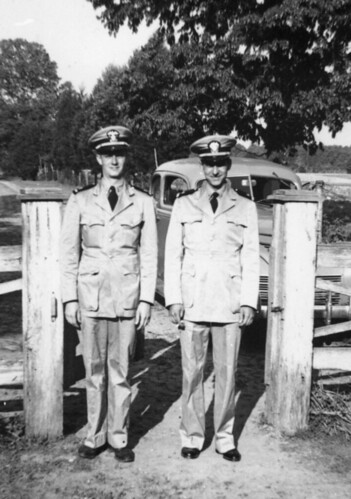
May 1, 1942

Buck & Pickett001
Standing at the front gate of Riverview Farm in service to the United States Navy, on the left, my father, on the right, my uncle Pickett.

Tuesday, June 13, 2006

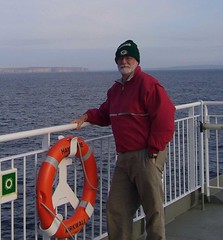
For My Packer Friends

BibbonFerryThe photo was taken aboard the Northlinks ferry MV Hamnavoe off the coast of mainland Scotland and Stromness, a port on the Orkney Islands. This was the only time I had opportunity to wear my GB Packer cap as the weather was otherwise too warm.

I will have more photos next week. Between now and then I will travel to Virginia to visit with my mother and attend the funeral of my uncle who passed away this morning.

Steptoe Pickett Edwards (Pickett), was 95. I posted about him last year. More later when I feel a bit less sad.