Monday, July 04, 2005

From the Halls of Montezuma...

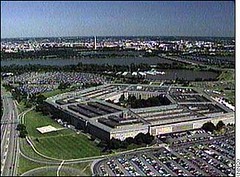
pentagon.largeI became curious the other day just how many times our country has "officially" used military troops abroad. Fortunately someone in our government has been keeping count. Compiled by Richard F. Grimmett, a researcher at the Library of Congress, this list - a update of a 1993 report - was completed last year. I found it on a US Air Force web site.

The 1993 report, itself based on one in 1975, listed 234 instances, to which another 86 were added in the subsequent twelve years for the 2004 report. That is 320 instances in a bit over 200 years we have been a country. No cost figures, either in dollars or human lives are given. It is, at best, a snapshot.

The opening paragraph reads as follows:
The following list reviews hundreds of instances in which the United States has utilized military forces abroad in situations of military conflict or potential conflict to protect US citizens or promote US interests. The list does not include covert actions (emphasis added) or numerous instances in which US forces have been stationed abroad since World War II in occupation forces or for participation in mutual security organizations, base agreements, or routine military assistance or training operations. Because of differing judgments over the actions to be included, other lists may include more or fewer instances.
The report goes on:
The instances vary greatly in size of operation, legal authorization, and significance. The number of troops involved range from a few sailors or Marines landed to protect American lives and property to hundreds of thousands in Vietnam and millions in World War II. Some actions were of short duration and some lasted a number of years. In some instances a military officer acted without authorization; some actions were conducted solely under the President's powers as Chief Executive or Commander in Chief; other instances were authorized by Congress in some fashion; five were declared wars. For most of the instances listed, however, the status of the action under domestic or international law has not been addressed. Thus inclusion in this list does not connote either legality or significance.
The report also does not mention sales or gifts of military supplies or training to friendly governments or insurgency movements.

I am sharing part of this list, only events post WW2 - my lifetime, as a reminder of how our country must appear to the rest of the world. WorldMilitarySpending
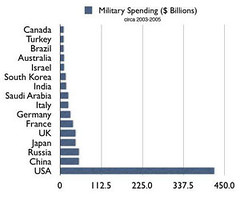
While many of us may have forgotten our liberal use of military force to obtain ends we considered appropriate at the time, I don't think those watching us abroad have. Certainly our record of world-wide military intervention is unmatched, as are the costs we seem willing to pay.

Click on the graphic below for the latest budget figures.
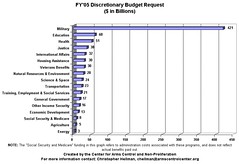
fy05Budget


US Military Intervention 1946-2004

1946 -- Trieste. President Truman ordered the augmentation of US troops along the zonal occupation line and the reinforcement of air forces in northern Italy after Yugoslav forces shot down an unarmed US Army transport plane flying over Venezia Giulia. Earlier US naval units had been dispatched to the scene.

1948 -- Palestine. A marine consular guard was sent to Jerusalem to protect the US Consul General.

1948 -- Berlin. After the Soviet Union established a land blockade of the US, British, and French sectors of Berlin on June 24, 1948, the United States and its allies airlifted supplies to Berlin until after the blockade was lifted in May 1949.

1948-49 -- China. Marines were dispatched to Nanking to protect the American Embassy when the city fell to Communist troops, and to Shanghai to aid in the protection and evacuation of Americans.

1950-53 -- Korean War. The United States responded to North Korean invasion of South Korea by going to its assistance, pursuant to United Nations Security Council resolutions. US forces deployed in Korea exceeded 300,000 during the last year of the conflict. Over 36,600 US military were killed in action.

1950-55 -- Formosa (Taiwan). In June 1950 at the beginning of the Korean War, President Truman ordered the US Seventh Fleet to prevent Chinese Communist attacks upon Formosa and Chinese Nationalist operations against mainland China.

1954-55 -- China. Naval units evacuated US civilians and military personnel from the Tachen Islands.

1956 -- Egypt. A marine battalion evacuated US nationals and other persons from Alexandria during the Suez crisis.

1958 -- Lebanon. Marines were landed in Lebanon at the invitation of its government to help protect against threatened insurrection supported from the outside. The President's action was supported by a Congressional resolution passed in 1957 that authorized such actions in that area of the world.

1959-60 -- The Caribbean. 2d Marine Ground Task Force was deployed to protect US nationals during the Cuban crisis.

1962 -- Thailand. The 3d Marine Expeditionary Unit landed on May 17, 1962 to support that country during the threat of Communist pressure from outside; by July 30 the 5,000 marines had been withdrawn.

1962 -- Cuba. On October 22, President Kennedy instituted a "quarantine" on the shipment of offensive missiles to Cuba from the Soviet Union. He also warned Soviet Union that the launching of any missile from Cuba against nations in the Western Hemisphere would bring about US nuclear retaliation on the Soviet Union. A negotiated settlement was achieved in a few days.

1962-75 -- Laos. From October 1962 until 1975, the United States played an important role in military support of anti-Communist forces in Laos.

1964 -- Congo. The United States sent four transport planes to provide airlift for Congolese troops during a rebellion and to transport Belgian paratroopers to rescue foreigners.

1964-73 -- Vietnam War. US military advisers had been in South Vietnam for a decade, and their numbers had been increased as the military position of the Saigon government became weaker. After citing what he termed were attacks on US destroyers in the Tonkin Gulf, President Johnson asked in August 1964 for a resolution expressing US determination to support freedom and protect peace in Southeast Asia. Congress responded with the Tonkin Gulf Resolution, expressing support for "all necessary measures" the President might take to repel armed attacks against US forces and prevent further aggression. Following this resolution, and following a Communist attack on a US installation in central Vietnam, the United States escalated its participation in the war to a peak of 543,000 military personnel by April 1969.

1965 -- Dominican Republic. The United States intervened to protect lives and property during a Dominican revolt and sent more troops as fears grew that the revolutionary forces were coming increasingly under Communist control.

1967 -- Congo. The United States sent three military transport aircraft with crews to provide the Congo central government with logistical support during a revolt.

1970 -- Cambodia. US troops were ordered into Cambodia to clean out Communist sanctuaries from which Viet Cong and North Vietnamese attacked USand South Vietnamese forces in Vietnam. The object of this attack, which lasted from April 30 to June 30, was to ensure the continuing safe withdrawal of American forces from South Vietnam and to assist the program of Vietnamization.

1974 -- Evacuation from Cyprus. United States naval forces evacuated US civilians during hostilities between Turkish and Greek Cypriot forces.

1975 -- Evacuation from Vietnam. On April 3, 1975, President Ford reported US naval vessels, helicopters, and Marines had been sent to assist in evacuation of refugees and US nationals from Vietnam.3

1975 -- Evacuation from Cambodia. On April 12, 1975, President Ford reported that he had ordered US military forces to proceed with the planned evacuation of US citizens from Cambodia.

1975 -- South Vietnam. On April 30 1975, President Ford reported that a force of 70 evacuation helicopters and 865 Marines had evacuated about 1,400 US citizens and 5,500 third country nationals and South Vietnamese from landing zones near the US Embassy in Saigon and the Tan Son Nhut Airfield.

1975 -- Mayaguez incident. On May 15, 1975, President Ford reported he had ordered military forces to retake the SS Mayaguez, a merchant vessel en route from Hong Kong to Thailand with U.S. citizen crew which was seized from Cambodian naval patrol boats in international waters and forced to proceed to a nearby island.

1976 -- Lebanon. On July 22 and 23, 1974, helicopters from five US naval vessels evacuated approximately 250 Americans and Europeans from Lebanon during fighting between Lebanese factions after an overland convoy evacuation had been blocked by hostilities.

1976 -- Korea. Additional forces were sent to Korea after two American soldiers were killed by North Korean soldiers in the demilitarized zone between North and South Korea while cutting down a tree.

1978 -- Zaire. From May 19 through June 1978, the United States utilized military transport aircraft to provide logistical support to Belgian and French rescue operations in Zaire.

1980 -- Iran. On April 26, 1980, President Carter reported the use of six US transport planes and eight helicopters in an unsuccessful attempt to rescue American hostages being held in Iran.

1981 -- El Salvador. After a guerilla offensive against the government of El Salvador, additional US military advisers were sent to El Salvador, bringing the total to approximately 55, to assist in training government forces in counterinsurgency.

1981 --Libya. On August 19, 1981, US planes based on the carrier USS Nimitz shot down two Libyan jets over the Gulf of Sidra after one of the Libyan jets had fired a heat-seeking missile. The United States periodically held freedom of navigation exercises in the Gulf of Sidra, claimed by Libya as territorial waters but considered international waters by the United States.

1982 -- Sinai. On March 19, 1982, President Reagan reported the deployment of military personnel and equipment to participate in the Multinational Force and Observers in the Sinai. Participation had been authorized by the Multinational Force and Observers Resolution, Public Law 97-132.

1982 -- Lebanon. On August 21, 1982, President Reagan reported the dispatch of 80 marines to serve in the multinational force to assist in the withdrawal of members of the Palestine Liberation force from Beirut. The Marines left September 20, 1982.

1982-1983 -- Lebanon. On September 29, 1982, President Reagan reported the deployment of 1200 marines to serve in a temporary multinational force to facilitate the restoration of Lebanese government sovereignty. On Sept. 29, 1983, Congress passed the Multinational Force in Lebanon Resolution (P.L. 98-119) authorizing the continued participation for eighteen months.

1983 -- Egypt. After a Libyan plane bombed a city in Sudan on March 18, 1983, and Sudan and Egypt appealed for assistance, the United States dispatched an AWACS electronic surveillance plane to Egypt.

1983-89 -- Honduras. In July 1983 the United States undertook a series of exercises in Honduras that some believed might lead to conflict with Nicaragua. On March 25, 1986, unarmed US military helicopters and crewmen ferried Honduran troops to the Nicaraguan border to repel Nicaraguan troops.

1983 -- Chad. On August 8, 1983, President Reagan reported the deployment of two AWACS electronic surveillance planes and eight F-15 fighter planes and ground logistical support forces to assist Chad against Libyan and rebel forces.

1983 -- Grenada. On October 25, 1983, President Reagan reported a landing on Grenada by Marines and Army airborne troops to protect lives and assist in the restoration of law and order and at the request of five members of the Organization of Eastern Caribbean States.

1984 -- Persian Gulf. On June 5, 1984, Saudi Arabian jet fighter planes, aided by intelligence from a US AWACS electronic surveillance aircraft and fueled by a U.S. KC-10 tanker, shot down two Iranian fighter planes over an area of the Persian Gulf proclaimed as a protected zone for shipping.

1985 -- Italy. On October 10, 1985, US Navy pilots intercepted an Egyptian airliner and forced it to land in Sicily. The airliner was carrying the hijackers of the Italian cruise ship Achille Lauro who had killed an American citizen during the hijacking.

1986 -- Libya. On March 26, 1986, President Reagan reported to Congress that, on March 24 and 25, US forces, while engaged in freedom of navigation exercises around the Gulf of Sidra, had been attacked by Libyan missiles and the United States had responded with missiles.

1986 -- Libya. On April 16, 1986, President Reagan reported that US air and naval forces had conducted bombing strikes on terrorist facilities and military installations in Libya.

1986 -- Bolivia. US Army personnel and aircraft assisted Bolivia in anti-drug operations.

1987-88 -- Persian Gulf. After the Iran-Iraq War resulted in several military incidents in the Persian Gulf, the United States increased US joint military forces operations in the Persian Gulf and adopted a policy of reflagging and escorting Kuwaiti oil tankers through the Gulf. President Reagan reported that US ships had been fired upon or struck mines or taken other military action on September 23, October 10, and October 20, 1987 and April 19, July 4, and July 14, 1988. The United States gradually reduced its forces after a cease-fire between Iran and Iraq on August 20, 1988.

1988 -- Panama. In mid-March and April 1988, during a period of instability in Panama and as pressure grew for Panamanian military leader General Manuel Noriega to resign, the United States sent 1,000 troops to Panama, to "further safeguard the canal, US lives, property and interests in the area." The forces supplemented 10,000 US military personnel already in Panama.

1989 -- Libya. On January 4, 1989, two US Navy F-14 aircraft based on the USS John F. Kennedy shot down two Libyan jet fighters over the Mediterranean Sea about 70 miles north of Libya. The US pilots said the Libyan planes had demonstrated hostile intentions.

1989 -- Panama. On May 11, 1989, in response to General Noriega's disregard of the results of the Panamanian election, President Bush ordered a brigade-sized force of approximately 1,900 troops to augment the estimated 11,000 US forces already in the area.

1989 -- Andean Initiative in War on Drugs. On September 15, 1989, President Bush announced that military and law enforcement assistance would be sent to help the Andean nations of Colombia, Bolivia, and Peru combat illicit drug producers and traffickers. By mid-September there were 50-100 US military advisers in Colombia in connection with transport and training in the use of military equipment, plus seven Special Forces teams of 2-12 persons to train troops in the three countries.

1989 -- Philippines. On December 2, 1989, President Bush reported that on December 1 US fighter planes from Clark Air Base in the Philippines had assisted the Aquino government to repel a coup attempt. In addition, 100 marines were sent from the US Navy base at Subic Bay to protect the US Embassy in Manila.

1989-90 -- Panama. On December 21, 1989, President Bush reported that he had ordered US military forces to Panama to protect the lives of American citizens and bring General Noriega to justice. By February 13, 1990, all the invasion forces had been withdrawn.

1990 -- Liberia. On August 6, 1990, President Bush reported that a reinforced rifle company had been sent to provide additional security to the US Embassy in Monrovia, and that helicopter teams had evacuated US citizens from Liberia.

1990 -- Saudi Arabia. On August 9, 1990, President Bush reported that he had ordered the forward deployment of substantial elements of the US armed forces into the Persian Gulf region to help defend Saudi Arabia after the August 2 invasion of Kuwait by Iraq. On November 16, 1990, he reported the continued buildup of the forces to ensure an adequate offensive military option.

1991 -- Iraq. On January 18, 1991, President Bush reported that he had directed US armed forces to commence combat operations on January 16 against Iraqi forces and military targets in Iraq and Kuwait, in conjunction with a coalition of allies and UN Security Council resolutions. On January 12 Congress had passed the Authorization for Use of Military Force against Iraq Resolution (P.L. 102-1). Combat operations were suspended on February 28, 1991.

1991 -- Iraq. On May 17, 1991, President Bush stated in a status report to Congress that the Iraqi repression of the Kurdish people had necessitated a limited introduction of US forces into northern Iraq for emergency relief purposes.

1991 -- Zaire. On September 25-27, 1991, after widespread looting and rioting broke out in Kinshasa, US Air Force C-141s transported 100 Belgian troops and equipment into Kinshasa. US planes also carried 300 French troops into the Central African Republic and hauled back American citizens and third country nationals from locations outside Zaire.

1992 -- Sierra Leone. On May 3, 1992, US military planes evacuated Americans from Sierra Leone, where military leaders had overthrown the government.

1992 -- Kuwait. On August 3, 1992, the United States began a series of military exercises in Kuwait, following Iraqi refusal to recognize a new border drawn up by the United Nations and refusal to cooperate with UN inspection teams.

1992 -- Iraq. On September 16, 1992 President Bush stated in a status report to Congress that he had ordered US participation in the enforcement of a prohibition against Iraqi flights in a specified zone in southern Iraq, and aerial reconnaissance to monitor Iraqi compliance with the cease-fire resolution.

1992 -- Somalia. On December 10, 1992, President Bush reported that he had deployed US armed forces to Somalia in response to a humanitarian crisis and a UN Security Council Resolution determining that the situation constituted a threat to international peace. This operation, called Operation Restore Hope, was part of a US-led United Nations Unified Task Force (UNITAF) and came to an end on May 4, 1993. US forces continued to participate in the successor United Nations Operation in Somalia (UNOSOM II), which the UN Security Council authorized to assist Somalia in political reconciliation and restoration of peace.

1993 -- Iraq. On January 19, 1993, President Bush said in a status report that on December 27, 1992, US aircraft shot down an Iraqi aircraft in the prohibited zone; on January 13 aircraft from the United States and coalition partners had attacked missile bases in southern Iraq; and further military actions had occured on January 17 and 18. Administration officials said the United States was deploying a battalion task force to Kuwait to underline the continuing US commitment to Kuwaiti independence.

1993 -- Iraq. On January 21, 1993, shortly after his inauguration, President Clinton said the United States would continue the Bush policy on Iraq, and US aircraft fired at targets in Iraq after pilots sensed Iraqi radar or anti-aircraft fire directed at them.

1993 -- Bosnia. On February 28, 1993, the United States bagan an airdrop of relief supplies aimed at Muslims surrounded by Serbian forces in Bosnia.

1993 -- Bosnia. On April 13, 1993, President Clinton reported US forces were participating in a NATO air action to enforce a UN ban on all unauthorized military flights over Bosnia-Hercegovina.

1993 -- Iraq. In a status report on Iraq of May 24, President Clinton said that on April 9 and April 18 US warplanes had bombed or fired missiles at Iraqi anti-aircraft sites which had tracked US aircraft.

1993 -- Somalia. On June 10, 1993, President Clinton reported that in response to attacks against UN forces in Somalia by a factional leader, the US Quick Reaction Force in the area had participated in military action to quell the violence. On July 1, President Clinton reported further air and ground military operations on June 12 and June 17 aimed at neutralizing military capabilities that had impeded UN efforts to deliver humanitarian relief and promote national reconstruction, and additional instances occurred in the following months.

1993 -- Iraq. On June 28, 1993, President Clinton reported that on June 26 US naval forces had launched missiles against the Iraqi Intelligence Service's headquarters in Baghdad in response to an unsuccessful attempt to assassinate former President Bush in Kuwait in April 1993.

1993 -- Iraq. In a status report of July 22, 1993, President Clinton said on June 19 a US aircraft had fired a missile at an Iraqi anti-aircraft site displaying hostile intent. US planes also bombed an Iraqi missile battery on August 19, 1993.

1993 -- Macedonia. On July 9, 1993, President Clinton reported the deployment of 350 US soldiers to the former Yugoslav Republic of Macedonia to participate in the UN Protection Force to help maintain stability in the area of former Yugoslavia.

1993 -- Haiti. On October 20, 1993, President Clinton reported that US ships had begun to enforce a UN embargo against Haiti.

1994 -- Bosnia. On February 17, 1994, President Clinton reported that the United States had expanded its participation in United Nations and NATO efforts to reach a peaceful solution to the conflict in former Yugoslavia and that 60 US aircraft were available for participation in the authorized NATO missions.

1994 -- Bosnia. On March 1, 1994, President Clinton reported that on February 28 US planes patrolling the "no-fly zone" in former Yugoslavia under the North Atlantic Treaty Organization (NATO) shot down 4 Serbian Galeb planes.

1994 -- Bosnia. On April 12, 1994, President Clinton reported that on April 10 and 11, US warplanes under NATO command had fired against Bosnian Serb forces shelling the "safe" city of Gorazde.

1994 -- Rwanda. On April 12, 1994, President Clinton reported that combat-equipped US military forces had been deployed to Burundi to conduct possible non-combatant evacuation operations of US citizens and other third-country nationals from Rwanda, where widespread fighting had broken out. By September 30, 1994, all US troops had departed from Rwanda and surrounding nations. In the Defense Appropriations Act for FY1995 (P.L. 103-335, signed September 30, 1994), Congress barred use of funds for US military participation in or around Rwanda after October 7, 1994, except for any action necessary to protect US citizens.

1994 -- Macedonia. On April 19, 1994, President Clinton reported that the US contingent in the former Yugoslav Republic of Macedonia had been augmented by a reinforced company of 200 personnel.

1994 -- Haiti. On April 20, 1994, President Clinton reported that US naval forces had continued enforcement of the UN embargo in the waters around Haiti and that 712 vessels had been boarded since October 20, 1993.

1994 -- Bosnia. On August 22, 1994, President Clinton reported the use on August 5 of US aircraft under NATO to attack Bosnian Serb heavy weapons in the Sarajevo heavy weapons exclusion zone upon request of the UN Protection Forces.

1994 -- Haiti. On September 21, 1994, President Clinton reported the deployment of 1,500 troops to Haiti to restore democracy in Haiti. The troop level was subsequently increased to 20,000.

1994 -- Bosnia. On November 22, 1994, President Clinton reported the use of US combat aircraft on November 21, 1994, under NATO, to attack bases used by Serbs to attack the town of Bihac in Bosnia.

1994 -- Macedonia. On December 22, 1994, President Clinton reported that the US Army contingent in the former Yugoslav Republic of Macedonia continued its peacekeeping mission and that the current contingent would soon be replaced by about 500 soldiers from the 3rd Battalion, 5th Cavalry Regiment, 1st Armored Division from Kirchgons, Germany.

1995 -- Somalia. On March 1, 1995, President Clinton reported that on February 27, 1995, 1,800 combat-equipped US armed forces personnel began deployment into Mogadishu, Somalia, to assist in the withdrawal of UN forces assigned there to the United Nations Operation in Somalia (UNOSOM II). This mission was completed on March 3, 1995.

1995 -- Haiti. On March 21, 1995, President Clinton reported that US military forces in Haiti as part of a UN Multinational Force had been reduced to just under 5,300 personnel. He noted that as of March 31, 1995, approximately 2,500 US personnel would remain in Haiti as part of the UN Mission in Haiti (UNMIH).

1995 -- Bosnia. On May 24, 1995, President Clinton reported that US combat-equipped fighter aircraft and other aircraft continued to contribute to NATO's enforcement of the no-fly zone in airspace over Bosnia-Herzegovina. US aircraft, he noted, were also available for close air support of UN forces in Croatia. Roughly 500 US soldiers continued to be deployed in the former Yugoslav Republic of Macedonia as part of the UN Preventive Deployment Force (UNPREDEP). US forces continued to support UN refugee and embargo operations in this region.

1995 -- Bosnia. On September 1, 1995, President Clinton reported that "US combat and support aircraft" had been used beginning on August 29, 1995, in a series of NATO air strikes against Bosnian Serb Army (BSA) forces in Bosnia-Herzegovina that were threatening the UN-declared safe areas of Sarajevo, Tuzla, and Gorazde. He noted that during the first day of operations, "some 300 sorties were flown against 23 targets in the vicinity of Sarajevo, Tuzla, Gorazde and Mostar."

1995 -- Haiti. On September 21, 1995, President Clinton reported that currently the United States had 2,400 military personnel in Haiti as participants in the UN Mission in Haiti (UNMIH). In addition, 260 US military personnel were assigned to the US Support Group Haiti.

1995 -- Bosnia. On December 6, 1995, President Clinton reported to Congress, that he had "ordered the deployment of approximately 1,500 US military personnel" to Bosnia-Herzegovina and Croatia as part of a NATO "enabling force" to lay the groundwork for the prompt and safe deployment of the NATO-led Implementation Force (IFOR)," which would be used to implement the Bosnian peace agreement after its signing. The President also noted that he had authorized deployment of roughly 3,000 other US military personnel to Hungary, Italy, and Croatia to establish infrastructure for the enabling force and the IFOR.

1995 -- Bosnia. On December 21, 1995, President Clinton reported to Congress that he had ordered the deployment of approximately 20,000 US military personnel to participate in the NATO-led Implementation Force (IFOR) in the Republic of Bosnia-Herzegovina, and approximately 5,000 US military personnel would be deployed in other former Yugoslav states, primarily in Croatia. In addition, about 7,000 US support forces would be deployed to Hungary, Italy and Croatia and other regional states in support of IFOR's mission.

1996 -- Haiti. On March 21, 1996, President Clinton reported to Congress that beginning in January 1996 there had been a "phased reduction" in the number of United States personnel assigned to the United Nations Mission in Haiti (UNMIH). As of March 21, 309 US personnel remained a part of UNMIH. These US forces were "equipped for combat."

1996 -- Liberia. On April 11, 1996, President Clinton reported to Congress that on April 9, 1996 due to the "deterioration of the security situation and the resulting threat to American citizens" in Liberia he had ordered US military forces to evacuate from that country "private US citizens and certain third-country nationals who had taken refuge in the US Embassy compound...."

1996 -- Liberia. On May 20, 1996, President Clinton reported to Congress the continued deployment of US military forces in Liberia to evacuate both American citizens and other foreign personnel, and to respond to various isolated "attacks on the American Embassy complex" in Liberia. The President noted that the deployment of US forces would continue until there was no longer any need for enhanced security at the Embassy and a requirement to maintain an evacuation capability in the country.

1996 -- Central African Republic. On May 23, 1996, President Clinton reported to Congress the deployment of US military personnel to Bangui, Central African Republic, to conduct the evacuation from that country of "private US citizens and certain U.S. Government employees," and to provide "enhanced security for the American Embassy in Bangui."

1996 -- Bosnia. On June 21, 1996, President Clinton reported to Congress that United States forces totaling about 17,000 remain deployed in Bosnia "under NATO operational command and control" as part of the NATO Implementation Force (IFOR). In addition, about 5,500 US military personnel were deployed in Hungary, Italy and Croatia, and other regional states to provide "logistical and other support to IFOR." The President noted that it was the intention that IFOR would complete the withdrawal of all troops in the weeks after December 20, 1996, on a schedule "set by NATO commanders consistent with the safety of troops and the logistical requirements for an orderly withdrawal." He also noted that a US Army contingent (of about 500 US soldiers) remained in the Former Yugoslav Republic of Macedonia as part of the United Nations Preventive Deployment Force (UNPREDEP).

1996 -- Rwanda and Zaire. On December 2, 1996, President Clinton reported to Congress that to support the humanitarian efforts of the United Nations regarding refugees in Rwanda and the Great Lakes Region of Eastern Zaire, he had authorized the use of US personnel and aircraft, including AC-130U planes to help in surveying the region in support of humanitarian operations, although fighting still was occurring in the area, and US aircraft had been subject to fire when on flight duty.

1996 -- Bosnia. On December 20, 1996, President Clinton reported to Congress that he had authorized US participation in an IFOR follow-on force in Bosnia, known as SFOR (Stabilization Force), under NATO command. The President said the US forces contribution to SFOR was to be "about 8,500" personnel whose primary mission is to deter or prevent a resumption of hostilities or new threats to peace in Bosnia. SFOR's duration in Bosnia is expected to be 18 months, with progressive reductions and eventual withdrawal.

1997 -- Albania. On March 15, 1997, President Clinton reported to Congress that on March 13, 1997, he had utilized US military forces to evacuate certain U.S. Government employees and private US citizens from Tirana, Albania, and to enhance security for the US Embassy in that city.

1997 -- Congo and Gabon. On March 27, 1997, President Clinton reported to Congress that, on March 25, 1997, a standby evacuation force of US military personnel had been deployed to Congo and Gabon to provide enhanced security for American private citizens, government employees, and selected third country nationals in Zaire, and to be available for any necessary evacuation operation.

1997 -- Sierra Leone. On May 30, 1997, President Clinton reported to Congress that on May 29 and May 30, 1997, US military personnel were deployed to Freetown, Sierra Leone, to prepare for and undertake the evacuation of certain US government employees and private US citizens.

1997 -- Bosnia. On June 20, 1997, President Clinton reported to Congress that US Armed Forces continued to support peacekeeping operations in Bosnia and other states in the region in support of the NATO-led Stabilization Force (SFOR). He reported that currently most US military personnel involved in SFOR were in Bosnia, near Tuzla, and about 2,800 US troops were deployed in Hungary, Croatia, Italy, and other regional states to provide logistics and other support to SFOR. A US Army continent of about 500 also remained in the Former Yugoslav Republic of Macedonia as part of the UN Preventive Deployment Force (UNPREDEP).

1997 -- Cambodia. On July 11, 1997, President Clinton reported to Congress that in an effort to ensure the security of American citizens in Cambodia during a period of domestic conflict there, he had deployed a Task Force of about 550 US military personnel to Utapao Air Base in Thailand. These personnel were to be available for possible emergency evacuation operations in Cambodia as deemed necessary.

1997 -- Bosnia. On December 19, 1997, President Clinton reported to Congress that he intended "in principle" to have the United States participate in a security presence in Bosnia when the NATO SFOR contingent withdrew in the summer of 1998.

1998 -- Guinea-Bissau. On June 12, 1998, President Clinton reported to Congress that, on June 10, 1998, in response to an army mutiny in Guinea-Bissau endangering the US Embassy, US government employees and citizens in that country, he had deployed a standby evacuation force of US military personnel to Dakar, Senegal, to remove such individuals, as well as selected third country nationals, from the city of Bissau. The deployment continued until the necessary evacuations were completed.

1998 -- Bosnia. On June 19, 1998, President Clinton reported to Congress regarding activities in the last six months of combat-equipped US forces in support of NATO's SFOR in Bosnia and surrounding areas of former Yugoslavia.

1998 -- Kenya and Tanzania. On August 10, 1998, President Clinton reported to Congress that he had deployed, on August 7, 1998, a Joint Task Force of US military personnel to Nairobi, Kenya, to coordinate the medical and disaster assistance related to the bombings of the U.S. Embassies in Kenya and Tanzania. He also reported that teams of 50-100 security personnel had arrived in Nairobi, Kenya, and Dar es Salaam, Tanzania, to enhance the security of the US Embassies and citizens there.

1998 -- Albania. On August 18, 1998, President Clinton reported to Congress that he had, on August 16, 1998, deployed 200 US Marines and 10 Navy SEALS to the US Embassy compound in Tirana, Albania, to enhance security against reported threats against US personnel.

1998 -- Afghanistan and Sudan. On August 21, 1998, by letter, President Clinton reported to Congress that he had authorized airstrikes on August 20th against camps and installations in Afghanistan and Sudan used by the Osama bin Laden terrorist organization. The President did so based on what he viewed as convincing information that the bin Laden organization was responsible for the bombings, on August 7, 1998, of the US Embassies in Kenya and Tanzania.

1998 -- Liberia. On September 29, 1998, President Clinton reported to Congress that on September 27, 1998 he had, due to political instability and civil disorder in Liberia, deployed a stand-by response and evacuation force of 30 US military personnel to augment the security force at the US Embassy in Monrovia, and to provide for a rapid evacuation capability, as needed, to remove US citizens and government personnel from the country.

1998 -- Iraq. During the period from December 16-23, 1998, the United States, together with the United Kingdom, conducted a bombing campaign, termed Operation Desert Fox, against Iraqi industrial facilities deemed capable of producing weapons of mass destruction, and against other Iraqi military and security targets.

1998 -1999 Iraq. Beginning in late December 1998, and continuing during 1999, the United States, together with forces of the coalition enforcing the "no-fly" zones over Iraq, conducted military operations against the Iraqi air defense system on numerous occasions in response to actual or potential threats against aircraft enforcing the "no-fly" zones in northern and southern Iraq.

1999 -- Bosnia. On January 19, 1999, President Clinton reported to Congress that he was continuing to authorize the use of combat-equipped US Armed Forces in Bosnia and other states in the region as participants in and supporters of the NATO-led Stabilization Force (SFOR). He noted that the US SFOR military personnel totaled about 6,900, with about 2,300 US military personnel deployed to Hungary, Croatia, Italy and other regional states. Also some 350 US military personnel remain deployed in the Former Yugoslav Republic of Macedonia (FYROM) as part of the UN Preventive Deployment Force (UNPREDEP).

1999 -- Kenya. On February 25, 1999, President Clinton reported to Congress that he was continuing to deploy US military personnel in that country to assist in providing security for the US embassy and American citizens in Nairobi, pending completion of renovations of the American embassy facility in Nairobi, subject of a terrorist bombing in August 1998.

1999 -- Yugoslavia. On March 26, 1999, President Clinton reported to Congress that, on March 24, 1999, US military forces, at his direction, and in coalition with NATO allies, had commenced air strikes against Yugoslavia in response to the Yugoslav government's campaign of violence and repression against the ethnic Albanian population in Kosovo.

1999 -- Yugoslavia/Albania. On April 7, 1999, President Clinton reported to Congress, that he had ordered additional US military forces to Albania, including rotary wing aircraft, artillery, and tactical missiles systems to enhance NATO's ability to conduct effective air operations in Yugoslavia. About 2,500 soldiers and aviators are to be deployed as part of this task force. The President also reported the deployment of US military forces to Albania and Macedonia to support humanitarian disaster relief operations for Kosovar refugees.

1999 -- Yugoslavia/Albania. On May 25, 1999, President Clinton reported to Congress, "consistent with the war Powers Resolution" that he had directed "deployment of additional aircraft and forces to support NATO's ongoing efforts [against Yugoslavia], including several thousand additional US Armed Forces personnel to Albania in support of the deep strike force located there." He also directed that additional US forces be deployed to the region to assist in "humanitarian operations."

1999 -- Yugoslavia/Kosovo. On June 12, 1999, President Clinton reported to Congress, "consistent with the War Powers Resolution" that he had directed the deployment of about "7,000 US military personnel as the US contribution to the approximately 50,000-member, NATO-led security force (KFOR)" currently being assembled in Kosovo. He also noted that about "1,500 US military personnel, under separate US command and control, will deploy to other countries in the region, as our national support element, in support of KFOR."

1999 -- Bosnia. On July 19, 1999, President Clinton reported to Congress "consistent with the War Powers Resolution" that about 6,200 US military personnel were continuing to participate in the NATO-led Stabilization Force (SFOR) in Bosnia, and that another 2,200 personnel were supporting SFOR operations from Hungary, Croatia, and Italy. He also noted that US military personnel remain in the Former Yugoslav Republic of Macedonia to support the international security presence in Kosovo (KFOR).

1999 -- East Timor. On October 8, 1999, President Clinton reported to Congress "consistent with the War Powers Resolution" that he had directed the deployment of a limited number of US military forces to East Timor to support the U.N. multinational force (INTERFET) aimed at restoring peace to East Timor. US support has been limited initially to "communications, logistics, planning assistance and transportation." The President further noted that he had authorized deployment of the amphibious ship USS Belleau Wood, together with its helicopters and her complement of personnel from the 31st Marine Expeditionary Unit (Special Operations Capable) (MEU SOC) to the East Timor region, to provide helicopter airlift and search and rescue support to the multinational operation. US participation was anticipated to continue until the transition to a UN peacekeeping operation was complete.

1999 -- Yugoslavia/Kosovo. On December 15, 1999, President Clinton reported to Congress "consistent with the War Powers Resolution" that U.S. combat-equipped military personnel continued to serve as part of the NATO-led security force in Kosovo (KFOR). He noted that the American contribution to KFOR in Kosovo was "approximately 8,500 US military personnel." US forces were deployed in a sector centered around "Urosevac in the eastern portion of Kosovo." For US KFOR forces, "maintaining public security is a key task." Other US military personnel are deployed to other countries in the region to serve in administrative and logistics support roles for US forces in KFOR. Of these forces, about 1,500 US military personnel are in Macedonia and Greece, and occasionally in Albania.

1999-2000 -- Iraq. At various times during 1999, and continuing throughout 2000 the United States, together with forces of the coalition enforcing the "no-fly" zones over Iraq, conducted military operations against the Iraqi air defense system on numerous occasions in response to actual or potential threats against aircraft enforcing the "no-fly" zones in northern and southern Iraq.

2000 -- Bosnia. On January 25, 2000, President Clinton reported to Congress "consistent with the War Powers Resolution" that the US continued to provide combat-equipped US Armed Forces to Bosnia-Herzegovina and other states in the region as part of the NATO led Stabilization Force (SFOR). The President noted that the US force contribution was being reduced from "approximately 6,200 to 4,600 personnel," with the US forces assigned to Multinational Division, North, centered around the city of Tuzla. He added that approximately 1,500 US military personnel were deployed to Hungary, Croatia, and Italy to provide "logistical and other support to SFOR," and that US forces continue to support SFOR in "efforts to apprehend persons indicted for war crimes."

2000 -- East Timor. On February 25, 2000, President Clinton reported to Congress "consistent with the War Powers Resolution" that he had authorized the participation of a small number of US military personnel in support of the United Nations Transitional Administration in East Timor (UNTAET), which has a mandate to maintain law and order throughout East Timor, and to facilitate establishment of an effective administration there, delivery of humanitarian assistance and support the building of self-government. The President reported that the US contingent was small: three military observers, and one judge advocate. To facilitate and coordinate US military activities in East Timor, the President also authorized the deployment of a support group (USGET), consisting of 30 US personnel. US personnel would be temporarily deployed to East Timor, on a rotational basis, and through periodic ship visits, during which US forces would conduct "humanitarian and assistance activities throughout East Timor." Rotational activities should continue through the summer of 2000.

2000 -- Sierra Leone. On May 12, 2000, President Clinton, "consistent with the War Powers Resolution" reported to Congress that he had ordered a US Navy patrol craft to deploy to Sierra Leone to be ready to support evacuation operations from that country if needed. He also authorized a US C-17 aircraft to deliver "ammunition, and other supplies and equipment" to Sierra Leone in support of United Nations peacekeeping operations there.

2000 -- Yugoslavia/Kosovo. On June 16, 2000, President Clinton reported to Congress, "consistent with the War Powers Resolution," that the US was continuing to provide military personnel to the NATO-led KFOR security force in Kosovo. US forces were numbered at 7,500, but were scheduled to be reduced to 6,000 when ongoing troop rotations were completed. US forces in Kosovo are assigned to a sector centered near Gnjilane in eastern Kosovo. Other US military personnel are deployed to other countries serving in administrative and logistics support roles, with approximately 1,000 US personnel in Macedonia, Albania and Greece.

2000 -- Bosnia. On July 25, 2000, President Clinton reported to Congress, "consistent with the War Powers Resolution," that combat-equipped US military personnel continued to participate in the NATO-led Stabilization Force (SFOR) in Bosnia-Herzegovina, being deployed to Bosnia, and other states in the region in support of peacekeeping efforts in former Yugoslavia. US military personnel levels have been reduced from 6,200 to 4,600. Apart from the forces in Bosnia, approximately 1,000 US personnel continue to be deployed in support roles in Hungary, Croatia, and Italy.

2000 -- East Timor. On August 25, 2000, President Clinton reported to Congress,"consistent with the War Powers Resolution," that the United States was currently contributing three military observers to the United Nations Transitional Administration in East Timor (UNTAET) that is charged by the UN with restoring and maintaining peace and security there. He also noted that the US was maintaining a military presence in East Timor separate from UNTAET, comprised of about 30 US personnel who facilitate and coordinate US military activities in East Timor and rotational operations of US forces there. US forces currently conduct humanitarian and civic assistance activities for East Timor's citizens. US rotational presence operations in East Timor are presently expected, the President said, to continue through December 2000.

2000 -- Yemen. On October 14, 2000, President Clinton reported to Congress, "consistent with the War Powers Resolution," that on October 12, 2000, in the wake of an attack on the USS Cole in the port of Aden, Yemen, he had authorized deployment of about 45 military personnel from US Naval Forces Central Command to Aden to provide "medical, security, and disaster response assistance." The President further reported that on October 13, 2000 about 50 US military security personnel arrived in Aden, and that additional "security elements" may be deployed to the area, to enhance the ability of the US to ensure the security of the USS Cole and the personnel responding to the incident. In addition, two US Navy surface combatant vessels are operating in or near Yemeni territorial waters to provide communications and other support, as required.

2000 -- Yugoslavia/Kosovo. On December 18, 2000, President Clinton reported to Congress, "consistent with the War Powers Resolution," that the United States was continuing to provide approximately 5,600 US military personnel in support of peacekeeping efforts in Kosovo as part of the NATO-led international security force in Kosovo (KFOR). An additional 500 US military personnel are deployed as the National Support Element in Macedonia, with an occasional presence in Albania and Greece. US forces are assigned to a sector centered around Gnjilane in the eastern portion of Kosovo. The President noted that the mission for these US military forces is maintaining a safe and secure environment through conducting "security patrols in urban areas and in the countryside throughout their sector."

2001 -- East Timor. On March 2, 2001, President George W. Bush reported to Congress, "consistent with the War Powers Resolution," that US armed forces were continuing to support the United Nations peacekeeping effort in East Timor aimed at providing security and maintaining law and order in East Timor, coordinating delivery of humanitarian assistance, and helping establish the basis for self-government in East Timor. The US currently has three military observers attached to the United Nations Transitional Administration in East Timor (UNTAET). The United States also has a separate military presence, the US Support Group East Timor (USGET), of approximately 12 US personnel, including a security detachment, which "facilitates and coordinates" US military activities in East Timor.

2001 -- Yugoslavia/Kosovo. On May 18, 2001, President George W. Bush reported to Congress, "consistent with the War Powers Resolution," that the United States was continuing to provide approximately 6,000 US military personnel in support of peacekeeping efforts in Kosovo as part of the NATO-led international security force in Kosovo (KFOR). An additional 500 US military personnel are deployed as the National Support Element in Macedonia, with an occasional presence in Greece and Albania. US forces in Kosovo are assigned to a sector centered around Gnjilane in the eastern portion. President Bush noted that the mission for these US military forces is maintaining a safe and secure environment through conducting security patrols in urban areas and in the countryside through their sector.

2001 -- Bosnia. On July 25, 2001, President George W. Bush reported to Congress, "consistent with the War Powers Resolution, about 3,800 combat-equipped US Armed Forces continued to be deployed in Bosnia-Herzegovina, and other regional states as part of the NATO-led Stabilization Force (SFOR). Most were based at Tuzla in Bosnia. About 500 others were based in Hungary, Croatia, and Italy, providing logistical and other support.

2001 -- Iraq. At various times throughout 2001, the United States, together with forces of the coalition enforcing the "no-fly" zones over Iraq, conducted military operations against the Iraqi air defense system on numerous occasions in response to actual or potential threats against aircraft enforcing the "no-fly" zones in northern and southern Iraq.

2001 -- East Timor. On August 31, 2001, President George W. Bush reported to Congress, "consistent with the War Powers Resolution," that US armed forces were continuing to support the United Nations peacekeeping effort in East Timor aimed at providing security and maintaining law and order in East Timor, coordinating delivery of humanitarian assistance, and helping establish the basis for self-government in East Timor. The US currently has three military observers attached to the United Nations Transitional Administration in East Timor (UNTAET). The United States also has a separate military presence, the US Support Group East Timor (USGET), of approximately 20 US personnel, including a security detachment, which "facilitates and coordinates" US military activities in East Timor, as well as a rotational presence of US forces through temporary deployments to East Timor. The President stated that US forces would continue a presence through December 2001, while options for a US presence in 2002 are being reviewed, with the President's objective being redeployment of USGET personnel, as circumstances permit.

2001 -- Terrorism threat. On September 24, 2001, President George W. Bush reported to Congress, "consistent with the War Powers Resolution," and "Senate Joint Resolution 23" that in response to terrorist attacks on the World Trade Center and the Pentagon he had ordered the "deployment of various combat-equipped and combat support forces to a number of foreign nations in the Central and Pacific Command areas of operations." The President noted in efforts to "prevent and deter terrorism" he might find it necessary to order additional forces into these and other areas of the world...." He stated that he could not now predict "the scope and duration of these deployments," or the "actions necessary to counter the terrorist threat to the United States."

2001 -- Afghanistan. On October 9, 2001, President George W. Bush reported to Congress, "consistent with the War Powers Resolution," and "Senate Joint Resolution 23" that on October 7, 2001, US Armed Forces "began combat action in Afghanistan against Al Qaida terrorists and their Taliban supporters." The President stated that he had directed this military action in response to the September 11, 2001 attacks on US "territory, our citizens, and our way of life, and to the continuing threat of terrorist acts against the United States and our friends and allies." This military action was "part of our campaign against terrorism" and was "designed to disrupt the use of Afghanistan as a terrorist base of operations."

2001 -- Yugoslavia/Kosovo. On November 19, 2001, President George W. Bush reported to Congress, "consistent with the War Powers Resolution," that the United States was continuing to provide approximately 5,500 US military personnel in support of peacekeeping efforts in Kosovo as part of the NATO-led international security force in Kosovo (KFOR). An additional 500 US military personnel are deployed as the National Support Element in Macedonia, with an occasional presence in Greece and Albania. US forces in Kosovo are assigned to a sector centered around Gnjilane in the eastern portion. President Bush noted that the mission for these US military forces is maintaining a safe and secure environment through conducting security patrols in urban areas and in the countryside through their sector.

2002 -- Bosnia. On January 21, 2002, President George W. Bush reported to Congress, "consistent with the War Powers Resolution," that about 3,100 combat-equipped US Armed Forces continued to be deployed in Bosnia-Herzegovina, and other regional states as part of the NATO-led Stabilization Force (SFOR). Most American forces were based at Tuzla in Bosnia. About 500 others were based in Hungary, Croatia, and Italy, providing logistical and other support.

2002 -- East Timor. On February 28, 2002, President George W. Bush reported to Congress, "consistent with the War Powers Resolution," that US Armed Forces were continuing to support the United Nations peacekeeping effort in East Timor aimed at providing security and maintaining law and order in East Timor, coordinating delivery of humanitarian assistance, and helping establish the basis for self-government in East Timor. The United States currently has three military observers attached to the United Nations Transitional Administration in East Timor (UNTAET). The United States also has a separate military presence, the US Support Group East Timor (USGET), comprised of approximately 10 US personnel, including a security detachment, which "facilitates and coordinates" US military activities in East Timor, as well as a rotational presence of US forces through temporary deployments to East Timor. The President stated that US forces would continue a presence through 2002. The President noted his objective was to gradually reduce the "rotational presence operations," and to redeploy USGET personnel, as circumstances permitted.

2002 -- Terrorism threat. On March 20, 2002, President George W. Bush reported to Congress, "consistent with the War Powers Resolution,"on US efforts in the "global war on Terrorism." He noted that the "heart of the al-Qaeda training capability" had been "seriously degraded," and that the remainder of the Taliban and the al-Qaeda fighters were being "actively pursued and engaged by the US, coalition and Afghan forces." The US was also conducting "maritime interception operations...to locate and detain suspected al-Qaeda or Taliban leadership fleeing Afghanistan by sea." At the Philippine Government's invitation, the President had ordered deployed "combat-equipped and combat support forces to train with, advise, and assist" the Philippines' Armed Forces in enhancing their "existing counterterrorist capabilities." The strength of US military forces working with the Philippines was projected to be 600 personnel. The President noted that he was "assessing options" for assisting other nations, including Georgia and Yemen, in enhancing their "counterterrorism capabilities, including training and equipping their armed forces." He stated that US combat-equipped and combat support forces would be necessary for these efforts, if undertaken.

2002 -- Yugoslavia/Kosovo. On May 17, 2002, President George W. Bush reported to Congress, "consistent with the War Powers Resolution," that the US military was continuing to support peacekeeping efforts of the NATO-led international security force in Kosovo (KFOR). He noted that the current US contribution was about 5,100 military personnel, and an additional 468 personnel in Macedonia; with an occasional presence in Albania and Greece.

2002 -- Bosnia. On July 22, 2002, President George W. Bush reported to Congress, "consistent with the War Powers Resolution," that the US military was continuing to support peacekeeping efforts of the NATO-led Stabilization Force (SFOR) in Bosnia-Herzegovina and other regional states. He noted that the current US contribution was "approximately 2,400 personnel." Most US forces in Bosnia-Herzegovina are assigned to the Multinational Division, North headquartered in Tuzla. An additional 60 US military personnel are deployed to Hungary and Croatia to provide logistical and other support.

2002 -- Terrorism threat. On September 20, 2002, President Bush reported to Congress "consistent with the War Powers Resolution," that US "combat-equipped and combat support forces" have been deployed to the Philippines since January 2002 to train with, assist and advise the Philippines' Armed Forces in enhancing their "counterterrorist capabilities." He added that US forces were conducting maritime interception operations in the Central and European Command areas to combat movement, arming or financing of "international terrorists." He also noted that US combat personnel had been deployed to Georgia and Yemen to help enhance the "counterterrorist capabilities" of their armed forces.

2002 -- Cote d'Ivoire. On September 26, 2002, President Bush reported to Congress "consistent with the War Powers Resolution," that in response to a rebellion in Cote d'Ivoire that he had on September 25, 2002 sent US military personnel into Cote d'Ivoire to assist in the evacuation of American citizens and third country nationals from the city of Bouake; and otherwise assist in other evacuations as necessary.

2002 -- Yugoslavia/Kosovo. On November 15, 2002, the President reported to Congress "consistent with the War Powers Resolution" that the US was continuing to deploy combat equipped military personnel as part of the NATO-led international security force in Kosovo (KFOR). Currently there are approximately 4,350 US military personnel in Kosovo, with an additional 266 military personnel in Macedonia. The United States also has an occasional presence in Albania and Greece, associated with the KFOR mission.

2003 -- Bosnia. On January 21, 2003, President George W. Bush reported to Congress, "consistent with the War Powers Resolution," that about 1,800 US Armed Forces personnel continued to be deployed in Bosnia-Herzegovina, and other regional states as part of the NATO-led Stabilization Force (SFOR). Most were based at Tuzla in Bosnia. About 80 others were based in Hungary and Croatia, providing logistical and other support.

2003 -- Terrorism threat. On March 20, 2003, President Bush reported to Congress, "consistent with the War Powers Resolution," as well as P.L. 107-40, and "pursuant to" his authority as Commander-in-Chief, that he had continued a number of US military operations globally in the war against terrorism. These military operations included ongoing US actions against al-Qaeda fighters in Afghanistan; collaborative anti-terror operations with forces of Pakistan in the Pakistan/Afghanistan border area; "maritime interception operations on the high seas" in areas of responsibility of the Central and European Commands to prevent terrorist movement and other activities; and military support for the armed forces of Georgia and Yemen in counter-terrorism operations.

2003 -- Iraq War. On March 21, 2003, President Bush reported to Congress, "consistent with the War Powers Resolution," as well as P.L. 102-1 and P.L. 107-243, and "pursuant to" his authority as Commander-in-Chief, that he had "directed US Armed Forces, operating with other coalition forces, to commence operations on March 19, 2003, against Iraq." He further stated that it was not possible to know at present the duration of active combat operations or the scope necessary to accomplish the goals of the operation "to disarm Iraq in pursuit of peace, stability, and security both in the Gulf region and in the United States."

2003 -- Yugoslavia/Kosovo. On May 14, 2003, President Bush reported to Congress, "consistent with the War Powers Resolution," that combat-equipped US military personnel continued to be deployed as part of the NATO-led international security force in Kosovo (KFOR). He noted that about 2,250 US military personnel were deployed in Kosovo, and additional military personnel operated, on occasion, from Macedonia, Albania, and Greece in support of KFOR operations.

2003 -- Liberia. On June 9, 2003, President Bush reported to Congress, "consistent with the War Powers Resolution," that on June 8 he had sent about 35 combat-equipped US military personnel into Monrovia, Liberia, to augment US Embassy security forces, to aid in the possible evacuation of US citizens if necessary. The President also noted that he had sent about 34 combat-equipped US military personnel to help secure the US Embassy in Nouakchott, Mauritania, and to assist in evacuation of American citizens if required. They were expected to arrive at the US embassy by June 10, 2003. Back-up and support personnel were sent to Dakar, Senegal, to aid in any necessary evacuation from either Liberia or Mauritania.

2003 -- Bosnia. On July 22, 2003, President Bush reported to Congress, "consistent with the War Powers Resolution," that the United States continued to provide about 1,800 combat-equipped military personnel in Bosnia-Herzegovina in support of NATO's Stabilization Force (SFOR) and its peacekeeping efforts in this country.

2003 -- Liberia. On August 13, 2003, President Bush reported to Congress, "consistent with the War Powers Resolution," that in response to conditions in Liberia, on August 11, 2003, he had authorized about 4,350 US combat-equipped military personnel to enter Liberian territorial waters in support of UN and West African States efforts to restore order and provide humanitarian assistance in Liberia.

2003 -- Terrorism threat. On September 19, 2003, President Bush reported to Congress "consistent with the War Powers Resolution," that US "combat-equipped and combat support forces" continue to be deployed at a number of locations around the world as part of US anti-terrorism efforts. American forces support anti-terrorism efforts in the Philippines, and maritime interception operations continue on the high seas in the Central, European, and Pacific Command areas of responsibility, to "prevent the movement, arming, or financing of international terrorists." He also noted that "US combat equipped and support forces" had been deployed to Georgia and Djibouti to help in enhancing their "counterterrorist capabilities."

2003 -- Yugoslavia/Kosovo. On November 14, 2003, the President reported to Congress "consistent with the War Powers Resolution" that the United States was continuing to deploy combat equipped military personnel as part of the NATO-led international security force in Kosovo (KFOR). Currently there are approximately 2,100 US military personnel in Kosovo, with additional American military personnel operating out of Macedonia, Albania and Greece, in support of KFOR operations.

2004 -- Bosnia. On January 22, 2004, the President reported to Congress "consistent with the War Powers Resolution" that the United States was continuing to deploy combat equipped military personnel to Bosnia and Herzegovina in support of NATO's Stabilization Force (SFOR) and its peacekeeping efforts in this country. About 1,800 US personnel are participating.

2004 -- Haiti. On February 25, 2004, the President reported to Congress "consistent with the War Powers Resolution" that, on February 23, he had sent a combat-equipped "security force" of about "55 US military personnel from the US Joint Forces Command" to Port-au- Prince, Haiti to augment the US Embassy security forces there and to protect American citizens and property in light of the instability created by the armed rebellion in Haiti.

2004 -- Haiti. On March 2, 2004, the President reported to Congress "consistent with the War Powers Resolution" that on February 29 he had sent about "200 additional US combat-equipped, military personnel from the US Joint Forces Command" to Port-au-Prince, Haiti for a variety of purposes, including preparing the way for a UN Multinational Interim Force, and otherwise supporting UN Security Council Resolution 1529 (2004).

2004 -- Terrorism: Bosnia and Haiti. On March 20, 2004, the President reported to Congress "consistent with the War Powers Resolution," a consolidated report giving details of multiple on-going United States military deployments and operations "in support of the global war on terrorism (including in Afghanistan)," as well as operations in Bosnia and Herzegovina, Kosovo, and Haiti. In this report, the President noted that US anti-terror related activities were underway in Georgia, Djibouti, Kenya, Ethiopia, Yemen, and Eritrea. He further noted that US combat-equipped military personnel continued to be deployed in Kosovo as part of the NATO-led KFOR (1,900 personnel); in Bosnia and Herzegovina as part of the NATO-led SFOR (about 1,100 personnel); and approximately 1,800 military personnel were deployed in Haiti as part of the UN Multinational Interim Force.

Saturday, July 02, 2005

Our Greatest American, Ever

dsc_main_greatestI must have been distracted with less important matters last month because I completely missed the voting for the the Greatest American. It was only by reading the weekly column in one of the local newspapers where I spent my youth (notice that I didn't say grew up) written by a former student of mine that I learned that Ronald Reagan is our Greatest American. Imagine my surprise.

Curious as to how this came to be I googled around and learned the names of the nominees, the voting process, and the results. It seems that the Discovery Channel - with some help from AOL - and Matt Lauer of NBC entertainment were involved. Also implicated were several million internet voters who placed Mr. Reagan ahead of Abraham Lincoln (2), Martin Luther King, Jr. (3), George Washington (4), and Benjamin Franklin (5).

Not faring as well among the list of 100 nominees were Donald Trump, Dr. Phil, Michael Moore, Rush Limbaugh, Madonna, Michael Jackson, Hugh Heffner, Bret Favre (sorry Ms. M), Tom Cruise, and North Carolina's own John Edwards and Michael Jordan. Worthy nominees for sure, but all failed to make the top quartile. I was disappointed that Richard Petty was not nominated; but I guess you have to draw the line somewhere. Elvis (8) did make the top 10, just a notch ahead of Oprah (9), so I felt better.

Not wanting to choose between laughter and tears I googled again and found that the BBC had conducted a similar poll with about the same level of validity. I wonder who this polls' winner would have voted for? He would have received mine.

Thursday, June 30, 2005

the dutchess of coolsville

duchessI fell in love with Rickie Lee Jones and her music in the late 1970's shortly after hearing her self-titled first album. She was in her mid-20's and was riding the wave of her popular opening song, "Chuck E's in Love."

But one could tell from that first album that she was not interested in shaping her music to fit pop tastes or "stoking the starmaker machinery behind the popular song," as Joni Mitchell wrote. Her later dozen or so albums sold unevenly as she explored her different musical interests. But she remained a favorite of the music critics and an inspiration to female singer/songwriters. I never stopped listening either.

A couple of years ago I saw her live for the first time at the Barrymore in Madison. She was wonderful, now a grown woman leading her band all over the musical spectrum.

Now she has an anthology, duchess of coolsville on Rhino. It arrived last week, ordered in advance of release through her web site. Spanning her career the three disk set has it all, songs that define a style all her own - jazz, swing, pop, bebop - with lyrics that would be at home at a poetry improv.

Like most artists exploring edges, Rickie Lee has her share of misses. But when she gets it right, it is chicken-skin time.

Those interested in learning more about her music may find this 3-disc set a bit too eclectic. Her initial album still sounds fresh after all these years. It might be a good place to start. She also has a variety of live performances from over the years available through her web site.

I hear something different every time I listen to Rickie Lee. You might too. As Emmylou Harris wote in the liner notes, "...Rickie Lee still rules."

Monday, June 27, 2005

20/20's Seven Deadly Sins

abc_20_20Occupying that fuzzy wasteland between news and entertainment, ABC's 20/20 began a summer series last Friday night featuring the "Seven Deadly Sins." They blew it.

Instead of beginning with the sins we've all come to know and love since the 6th century, John Stossel and crew decided to start by recasting "Pride" into "Vanity." If Saint Gregory the Great wanted to include Vanity he would have. John, he chose Pride.

Instead of exploring Proud to be an American (Google's top search hit for that phrase) so close to the 4th of July we have pieces on teen boob-jobs, cut-rate plastic surgery, and "Reshape Your Body, and Reshape Your Life?". Of course, as we move deeper into the bathing suit season, female body parts were featured, all the better to kept the viewers tuned in for the commercials.

Never mind that Pride and Vanity are not the same thing. At best Vanity is a small physical subset of Pride, historically associated with women.

Never mind that the desire for makeovers - extreme or not - likely springs from insecurity, not Pride. Those were not vain women we saw; they were women with low self-esteem - insecure at best, self-loathing at worst.

Never mind that by transforming Pride into physical Vanity 20/20 managed to avoid dealing with many larger and more important issues wrapped in Pride: consumerism, social and economic class, racism, political rhetoric, military adventures abroad. Maybe ABC did not want to upset anyone in Washington.

John, Give Me a Break. With Barbara Walters and Geraldo Rivera watching, was this the best you could do?

Every now and then I get reminded that both ABC News and Mickey Mouse share the same address. 20/20? It is not Frontline, not yet anyway.

Wednesday, June 22, 2005

The Seven Deadly Sins, the Series

One of my favorite blogs, Locust Street, is currently posting from the baaaad section of town, the intersection of Music Avenue and Sin Street.slacker

Chris is beginning a series featuring the Seven Deadly Sins. Sloth just walked in and does not seem in a hurry to go anywhere.

I think I'll go take a nap.

Tuesday, June 21, 2005

Giving Us the Business

I don't know if it is just me getting older, but I am becoming increasing annoyed at the quality of writing I am finding in both print and electronic media these days. I am not talking about grammar, punctuation, or syntax. I am talking about the shallowness of the thinking that seems to underlie so many articles. It is bad enough that both Time and Newsweek have degenerated to the point where I am not sure whether I am reading a serious news magazine or a tabloid aimed at Wal-Mart checkout lanes. And if I have to turn past another "Special Advertising Section" I think I will puke. But it is what passes for business writing these days that make me wonder about the future of journalism. Please allow me to cite but two examples.

apple computerApple Computer, has been the subject of almost unbelieveably shortsighted and ultimately inaccurate business reporting by people who seem to have decided on their conclusion and then chose their facts accordingly. (sound familiar?) For at least ten years now business writers and computer industry observers have decided that the company must be going out of business, sustained only temporarily by cult-like zombies who don't have better sense than to just do what everybody else seemed to be doing, buying a generic Wintel PC. In fact a website has been keeping track of the Apple deathwatch for a number of years. The Mac Observer currently cites 46 "declared dead" articles since 1995.

Inconveniently, the company not only has survived, it is thriving. These articles seem humorous in hindsight until you think about how many people shied away from buying an Apple computer because of them.

Now with the obvious success of the iPod & the iTunes Store (Apple is no longer a computer company) and the pending switch to Intel processors (The mystique is gone and the cult will disappear) these same geniuses are predicting again the fall of Apple.

Yes, Apple has had its market failures. That sometimes seems to be the price of innovation and leadership. And as long as most PCs are bought for someone else to use - the enterprise market - price and not value will be all some of us choose to see. But one should remember it was only when Apple was run by suits - business types - and started to do what all the business analysts wanted them to do did they go in decline.

Happily for Apple and their customers Steve Jobs is back, that decline is over, and for those of us who simply want the best computer we can afford, we still have a choice; no thanks to Business Week, Money Magazine, PC Magazine, TheStreet.com, and just about every financial analyst on Wall Street.

Check out today's "Apple Courting Core Meltdown" at TheStreet. Core Meltdown? Why doesn't the author take one step further and write "The Possible End of Life on Earth" or "The Sky May Fall"? Yes, there are risks associated with the move to Intel chips. But this article is a great example of the usual glass always being - at best - half empty at Apple Computer.

If you want to really understand Apple, and the poor coverage they get in the business press, I suggest either of the MacJournals.

gmDid you know that General Motors vehicles have included in their sticker price between $1,500 and $2,000 of pension and medical costs while their (foreign) competitors generally have much less? Did you know that is one of the main reasons it lost $1.1 billion in the first quarter of 2005? Well if you did not know you certainly have not been paying attention to the business news recently. For the past couple of months we have been reading over and over this same story in the business press.

GM is now blaming their financial weakness on workers who accepted their generous compensation packages. In effect GM is seen as the victim of it's past labor agreements. Further, if the UAW does not rush back to the bargaining table and see to it that the workers give back some of this money there will be hell-to-pay. After all, what is good for General Motors.... Even George Will became an economist for a day with this message.

I suspect what we have here is a concerted effort by GM management and their PR flacks to put pressure on their union to negotiate money back into GM coffers. So business writers are fed all this pension and medical cost smoke and mirrors, the public believes it is getting expert inside analysis, the publishers their eyeballs, and hopefully - for GM - political pressure will mount on the union. Could George Will really be a shill? You betcha.

EconomistAt least one business magazine refused to play along. The Economist included in their June 9th issue an article titled "The Lost Years." It said in conclusion that,
The carmaker lost $1.1 billion during the first quarter and will not even make a forecast for the rest of the year. The reason for the collapse into loss was a slump in revenues caused by weak products.
The general thrust of the article is that GM has not been making cars good enough to succeed in the market place. That, coupled with other management induced failures, accounts for their current predictament. I suggest you read this article for a whiff a clean, non-Detroit, air.
I also suggest if you want to spend some time in the fountain of youth, drive a current GM car. I drove a recent Pontiac Grand Prix yesterday. It was like 1985 all over again.

GM is a classic example of the failure of success. Not even fawning writers can put this humpty dumpty back on that wall.

Tuesday, June 14, 2005

the U.S. Open

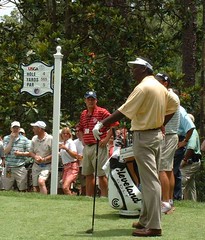
VijayYesterday, my wife, sister, brother-in-law and I attended the first practice round of the U.S. Open, played this year on Pinehurst #2 just a short drive minutes from my home.

As it was a practice round, the mood was as relaxed as could be expected at the beginning of arguably the most important golf championship in the world. The clouds and light wind brought a measure of relief as the temperature hovered around 90. The $2.50 bottled water was worth every penny.Vijay2
This was my first time walking Pinehurst #2, always ranked among the finest tests of golf in the world. After a difficult spring the weather had cooperated over the past few weeks; the course was in great shape. I have putted on greens that looked worse than the fairways we walked. As for all Opens, the roughs were thick and punishing.

But the main feature of the course is the genius of its designer, Donald Ross. Number 2 is just jaw-dropping beautiful, but it ways that test one's golf, not imagination. I was lucky enough to play as a youth many times on a Ross course, although I did not know it at the time. Those holes - among the last he ever designed - always seemed special to me. Watching from outside the ropes yesterday was difficult. I wanted to pick up my clubs and play!

Finally I was again reminded of the considerable gap between my golfing skills and those of the players we saw yesterday. Vijay Singh, currently the world's number 2 player, hit a drive shortly after I took the photo above that was longer, higher, and straighter that any I ever hit in my prime. Then he took a three-wood and did it again. Sure, modern equipment accounts for some of the difference, but not all. I am sure I hit a 300-yard drive or two in my career. Vijay averages over 300 yards and hits the fairway over 60 percent of the time. Damn! These guys are really, really, good.

Pinehurst #2 is a player's course, not a spectator's course. Given that and the even larger crowds once the tournament starts, I will be happy to be watching on TV this weekend as the championship is decided. But then I will have a bit more understanding of what it takes to play #2.

Sunday, June 12, 2005

Follow the Money

ATPM So, who gave us,"Follow the money"? Was it Deep Throat, a.k.a. Mark Felt? Apparently not. No, the most famous single line to come out of the Watergate scandel - other than that show stopper, "I am not a crook." - one that is welded deep in the American psyche, did not appear in reporter Woodward's notes, the pages of the Washington Post, nor Woodward and Bernstein's subsequent book. It was written for Hal Holbrook who played Deep Throat, in the movie version of the book, All the President's Men.

William Goldman, who also gave us Butch Cassidy and the Sundance Kid, Marathon Man and The Princess Bride is the author.Deep Throat

That revelation leads off todays Frank Rich column in the NY Times. I recommend it strongly, especially for you who either have only a hazy idea about what Watergate was about, or who have been wondering about the current state of news reporting in this country; or both.

Unless you want to pay to read the column, please be advised that NY Times.com on-line articles are available for free for only seven days. After that date I will edit this post using the old cut and paste.

June 23rd - As promised here is the full text:

June 12, 2005
Don't Follow the Money
By FRANK RICH

THE morning the Deep Throat story broke, the voice on my answering machine was as raspy as Hal Holbrook's. "I just want you to remember that I wrote 'Follow the money,' " said my caller. "I want to know if anybody will give me credit. Watch for the accuracy of the media!"

The voice belonged to my friend William Goldman, who wrote the movie "All the President's Men." His words proved more than a little prescient. As if on cue, journalists everywhere - from The New York Times to The Economist to The Washington Post itself - would soon start attributing this classic line of dialogue to the newly unmasked Deep Throat, W. Mark Felt. But the line was not in Woodward and Bernstein's book or in The Post's Watergate reportage or in Bob Woodward's contemporaneous notes. It was the invention of the author of "Butch Cassidy and the Sundance Kid," "Marathon Man" and "The Princess Bride."

This confusion of Hollywood's version of history with the genuine article would quickly prove symptomatic of the overall unreality of the Deep Throat coverage. Was Mr. Felt a hero or a villain? Should he "follow the money" into a book deal, and if so, how would a 91-year-old showing signs of dementia either write a book or schmooze about it with Larry King? How did Vanity Fair scoop The Post? How does Robert Redford feel about it all? Such were the questions that killed time for a nation awaiting the much-heralded feature mediathon, the Michael Jackson verdict.

Richard Nixon and Watergate itself, meanwhile, were often reduced to footnotes. Three years ago, on Watergate's 30th anniversary, an ABC News poll found that two-thirds of Americans couldn't explain what the scandal was, and no one was racing to enlighten them this time around. Vanity Fair may have taken the trouble to remind us that Watergate was a web of crime yielding the convictions and guilty pleas of more than 30 White House and Nixon campaign officials, but few others did. Watergate has gone back to being the "third-rate burglary" of Nixon administration spin. It is once again being covered up.

Not without reason. Had the scandal been vividly resuscitated as the long national nightmare it actually was, it would dampen all the Felt fun by casting harsh light on our own present nightmare. "The fundamental right of Americans, through our free press, to penetrate and criticize the workings of our government is under attack as never before" was how the former Nixon speech writer William Safire put it on this page almost nine months ago. The current administration, a second-term imperial presidency that outstrips Nixon's in hubris by the day, leads the attack, trying to intimidate and snuff out any Woodwards or Bernsteins that might challenge it, any media proprietor like Katharine Graham or editor like Ben Bradlee who might support them and any anonymous source like Deep Throat who might enable them to find what Carl Bernstein calls "the best obtainable version of the truth."

The attacks continue to be so successful that even now, long after many news organizations, including The Times, have been found guilty of failing to puncture the administration's prewar W.M.D. hype, new details on that same story are still being ignored or left uninvestigated. The July 2002 "Downing Street memo," the minutes of a meeting in which Tony Blair and his advisers learned of a White House effort to fix "the intelligence and facts" to justify the war in Iraq, was published by The London Sunday Times on May 1. Yet in the 19 daily Scott McClellan briefings that followed, the memo was the subject of only 2 out of the approximately 940 questions asked by the White House press corps, according to Eric Boehlert of Salon.

This is the kind of lapdog news media the Nixon White House cherished. To foster it, Nixon's special counsel, Charles W. Colson, embarked on a ruthless program of intimidation that included threatening antitrust action against the networks if they didn't run pro-Nixon stories. Watergate tapes and memos make Mr. Colson, who boasted of "destroying the old establishment," sound like the founding father of today's blogging lynch mobs. He exulted in bullying CBS to cut back its Watergate reports before the '72 election. He enlisted NBC in pro-administration propaganda by browbeating it to repackage 10-day-old coverage of Tricia Nixon's wedding as a prime-time special. It was the Colson office as well that compiled a White House enemies list that included journalists who had the audacity to question administration policies.

Such is the equivalently supine state of much of the news media today that Mr. Colson was repeatedly trotted out, without irony, to pass moral judgment on Mr. Felt - and not just on Fox News, the cable channel that is actually run by the former Nixon media maven, Roger Ailes. "I want kids to look up to heroes," Mr. Colson said, oh so sorrowfully, on NBC's "Today" show, condemning Mr. Felt for dishonoring "the confidence of the president of the United States." Never mind that Mr. Colson dishonored the law, proposed bombing the Brookings Institution and went to prison for his role in the break-in to steal the psychiatric records of The Times's Deep Throat on Vietnam, Daniel Ellsberg. The "Today" host, Matt Lauer, didn't mention any of this - or even that his guest had done jail time. None of the other TV anchors who interviewed Mr. Colson - and he was ubiquitous - ever specified his criminal actions in the Nixon years. Some identified him onscreen only as a "former White House counsel."

Had anyone been so rude (or professional) as to recount Mr. Colson's sordid past, or to raise the question of whether he was a hero or a traitor, the genealogical line between his Watergate-era machinations and those of his present-day successors would have been all too painfully clear. The main difference is that in the Nixon White House, the president's men plotted behind closed doors. The current administration is now so brazen it does its dirty work in plain sight.

In the most recent example, all the president's men slimed and intimidated Newsweek by accusing it of being an accessory to 17 deaths for its errant Koran story; led by Scott McClellan, they said it was unthinkable that any American guard could be disrespectful of Islam's holy book. These neo-Colsons easily drowned out Gen. Richard Myers, the chairman of the Joint Chiefs of Staff, and Afghanistan's president, Hamid Karzai, both of whom said that the riots that led to the 17 deaths were unrelated to Newsweek. Then came the pièce de résistance of Nixon mimicry: a Pentagon report certifying desecrations of the Koran by American guards was released two weeks after the Newsweek imbroglio, at 7:15 p.m. on a Friday, to assure it would miss the evening newscasts and be buried in the Memorial Day weekend's little-read papers.

At other times the new Colsons top the old one. Though Nixon aspired to punish public broadcasting by cutting its funding, he never imagined that his apparatchiks could seize the top executive positions at the Corporation for Public Broadcasting. Nor did he come up with the brilliant ideas of putting journalists covertly on the administration payroll and of hiring an outside P.R. firm (Ketchum) to codify an enemies list by ranking news organizations and individual reporters on the basis of how favorably they cover a specific administration policy (No Child Left Behind). President Bush has even succeeded in emasculating the post-Watergate reform that was supposed to help curb Nixonian secrecy, the Presidential Records Act of 1978.

THE journalists who do note the resonances of now with then rarely get to connect those dots on the news media's center stage of television. You are more likely to hear instead of how Watergate inspired too much "gotcha" journalism. That's a rather absurd premise given that no "gotcha" journalist got the goods on the biggest story of our time: the false intimations of incipient mushroom clouds peddled by American officials to sell a war that now threatens to match the unpopularity and marathon length of Vietnam.

Only once during the Deep Throat rollout did I see a palpable, if perhaps unconscious, effort to link the White House of 1972 with that of 2005. It occurred at the start, when ABC News, with the first comprehensive report on Vanity Fair's scoop, interrupted President Bush's post-Memorial Day Rose Garden news conference to break the story. Suddenly the image of the current president blathering on about how hunky-dory everything is in Iraq was usurped by repeated showings of the scene in which the newly resigned Nixon walked across the adjacent White House lawn to the helicopter that would carry him into exile.

But in the days that followed, Nixon and his history and the long shadows they cast largely vanished from the TV screen. In their place were constant nostalgic replays of young Redford and flinty Holbrook. Follow the bait-and-switch.

Friday, June 10, 2005

The Seven Deadly Sins

In my youth I spent a week in the city of San Francisco, just missing by a few months (!#&**!!!) the Summer of Love. I stayed with a friend on the campus of San Francisco State College, soon to become one of the most visible examples of 1960's college campus unrest. It was like going to the circus. I knew I didn't quite belong with the performers; but I knew that somewhere under that tent was a place for me.

Among the places I visited was the Haight-Ashbury district and nearby Golden Gate Park, where I attended an early spring "Human Be-in." I went to the Winterland and heard a band called Cream. My host suggested one afternoon that we drop by a house where some guys he knew lived. They had a band called the Grateful Dead. I opted instead to go to the famous San Francisco Zoo. My friends love this story.

newadventuresjesus_1969Somewhere on Ashbury street I bought a comic book called The New Adventures of Jesus, one of the first "underground comix," although I didn't know it at the time. I still have it, somewhere. The author, Frank Stack as Foolbert Sturgeon, has Jesus say at one point when confronting a mob of dim-bulb Galileans that, "The problem isn't sin, it's stupidity." For some reason that phrase has stuck with me since.

Given, IMHO, that there is only a very fine line between sin and stupidity, I have been thinking recently about the Seven Deadly Sins. For those of you who need reminding, they are (in ascending order of severity according to Dante): Lust, Gluttony, Greed, Sloth, Wrath, Envy, and Pride. I am personally thankful to Dante for that order.

When I was younger I thought these small fish to fry; I was after bigger game. Besides, although not in much official favor today, at one time the Seven Deadly (aka Capital or Cardinal) Sins were closely associated with the medieval Catholic Church, an institution I did not admire. In addition, they seemed so.... familiar, so....American.

Recently I have come to reassess my position. Large things from small things grow. Maybe looking at our lives and the choices we make through the lens of these sins is not a bad idea. It would also be tempting to begin a critique of the last 60 years of American life - including our foreign policy - from within their framework. But this is a blog post, not a dissertation.

So I invite you gentle readers, who are likely as free from these sins as I, to consider along with me the many ways we all might benefit if others would just get grip on their seven deadly sinfulness.

Monday, June 06, 2005

the Oxford American

OxAmericancoverLike a good idea that just won't go away, the Oxford American is back.

The magazine, which bills itself as "The Southern Magazine of Good Writing," was founded in 1992 in Oxford, Mississippi by Marc Smirnoff. It lasted only two years, folding for the first time in 1994. Author John Grisham, who was living in Oxford, resurrected it. While the critics loved it, it was a money loser. Grisham support ended, and so did the magazine, in 2001. By that time I was subscriber.

Having moved editorial offices to Little Rock, Arkansas, the magazine reappeared in 2002, only to fold again a year later. Now operating as a non-profit (not much of a stretch) it is enjoyed its fourth trip to the plate courtesy of the University of Central Arkansas, which has made a three-year investment of nearly $500,000.

With an editorial mission to "explore the American South," it has published original writing by many fine writers, including Donna Tartt, Charles Portis, Barry Hannah, Roy Blount, Jr., Tony Earley, John Jeremiah Sullivan, Wendy Brenner, Steve Martin, and Susan Sontag, not to mention William Faulkner, Walker Percy, James Agee, and Zora Neale Hurston. Its Southern Music Issue, complete with a CD, has been featured on NPR three years in a row and has won two National Magazine Awards for Best Single Topic Issue, most recently in 2004.

Smirnoff loves the south as only a "come here" can. I have just finished reading the latest issue, the first food issue, cover to cover. I laughted; I cried; I got hungry. The music issue is next. I can't wait.

If you care for the south, not the Southern Living version but the real one, the one that matters, and enjoy good writing, the Oxford American is for you. Subscribe to help ensure the magazine survives, or pick up issues that look interesting from a well-stocked magazine stand. Better hurry, ya hear?

Tuesday, May 31, 2005

John Harper Brent, Jr.

HarperBrent Harper Brent could have been my father, but he wasn't. He was my stepfather. We laid him to rest last weekend in the family cemetery at his childhood home, "Roanoke," in Heathsville in Virginia's Northern Neck. He was 85.

"Roanoke" is adjacent to Heathsville High School. It was there in the early 1930's when my mother and Harper began dating. Harper & Mother002But they drifted apart after mother moved to Richmond after graduation and Harper enrolled in V.P.I. - what today is called Virginia Tech. In 1940 Harper graduated with a degree in Electrical Engineering. Soon thereafter mother met another recently graduated electrical engineer, this one from UVA. He would become my father.

But before marriage or parenthood would come World War Two. Harper joined the Army, my father the Navy. Harper ended up in Europe while my father remained close to the US coast installing a new weapon of war, radar, on Navy ships. If Harper fired a gun or came under fire he did not speak of it to me. Instead he told stories of military support roles he played and the time he was almost caught behind the lines during the "Battle of the Bulge." I expect he saw more than he cared to talk about. He eventually rose to Captain, earned the Bronze Star, and developed a love for the nation he was helping liberate, France.

JeanBrentWhile his attempts to find employment in France after the war were unsuccessful, he had better luck with Gilberte Jeanne "Jean" Mourice, who became Mrs. Brent in early 1947.

Harper and Jean moved back to the states, spending their years together in the New York metro area. Harper had several employers as he came to specialize in industrial, commercial and military batteries. Harper&Jean Jean excelled in her role as the Parisian war bride, providing a bit of the exotic for her new southern in-laws. Although they had no children, they devoted themselves to their numerous cats, and, it seems, to each other.

Meanwhile, in 1942 my mother and father were married in - of all places - Harvard Chapel, Cambridge Massachusetts. My father was taking classes there in preparation for whatever assignment the Navy would have for him. A few days after VJ Day in 1945 they decided to start a family. I was born in May 1946, among the first of who would be called “boomers.” About the time Harper and Jean were sailing to America my father took a job in Southside Virginia with a small electrical cooperative. These electrical distribution companies were collectively known by the name of the federal governmental program that spawned them, REA co-ops. While Harper designed and built batteries, my father designed and built power lines to rural customers.

In the early 1980’s both Jean and my father died of cancer. A high school classmate told mother of the death Harper’s wife. Mother sent him a card of condolence. Before long exchanges of letters and phone calls led to visits. Harper married his high school sweetheart in 1983.

Harper retired and moved to mother’s home in Southside Virginia the following year. Harper&MotherAs much a traveler as my mother was not, Harper yanked mother out of her kitchen and to Alaska and France, among other destinations. Although both were by now set in their ways and often got along like oil and water, they were good for each other.

A couple of years ago Harper’s health began to fail. His lungs were weak, probably as result of industrial asbestos damage. His bones became brittle; osteoporosis ran in the family. Finally his short-term memory began to fail. Like the parson’s one-horse shay, last week Harper just gave out.

Harper was always kind and thoughtful to my sister and me. He was sensitive to the memory of my father and devoted to my mother. While he fought his growing disabilities, Harper complained little as his health failed, occasionally finding humor in his reduced circumstances. He was an inspiration to my daughter, instilling a love of France and the French language that is embedded deeply in her being.

Harper is back home now, lying beside Jean. We are sad; we will miss him. But perhaps we should be happy as we remember him, and his long and good life.

Thursday, May 26, 2005

the Bonny Blue

BonnieBlueLast week-end, my wife and I took a two-day excursion aboard the Bonny Blue. Amid our concerns about my step-father's failing health and my wife's new responsibilities as co-administrator of her late father's estate, the trip was a welcome bit of R & R. It was also a commemoration of our tenth wedding anniversary. It was like staying in a floating Bed & Breakfast.

It looked for a while as if we had chosen a bad week-end for an outing. The weather in Norfork on Friday was cool, windy and rainy. However both Saturday and Sunday, though still a bit cool, were wonderful days to be on the water.Canal1

Travel on this portion of the inland waterway is slow and peaceful. Most of the time we spent on the historic, man-made Dismal Swamp Canal. I had prepared for the trip by starting to read the recent The Fabulous History of the Dismal Swamp Company by Charles Royster. The remaining portion is on the scenic Pasquotank River.
Canal2
The Captain and crew were wonderful. With only sixteen passengers at a time the ship is not crowded and we had plenty of time to get to meet the other passengers and be waited on. The crew, high school students, were fun to watch. Several were new, learning both their hosting roles as well as how to crew a ship. They all agreed that it is the "best summer job, ever!"

Once docked at Elizabeth City, North Carolina we walked around, had great seafood dinner, and returned for a concert in the piano bar provided by Captain Jeff and the boat's designer and builder, Merritt Walter. We slept like ballast.
Canal3
Merritt Walter was a "passenger" for this trip as he is turning over daily operations of the Bonny Blue so he can work on other projects. Captain Walter is a retired Navy diver, boat builder and captain of federal research vessels. He is best know for his traditional "Rover" series of masted wooden sail vessels. An example is the Downeast Rover. The American Rover is another. He was a pleasure to talk with. He plays a mean "piano bar" keyboard too.Canal4

The return trip was equally relaxing, just what we needed. It was not quite the proverbial "slow boat to China." But last week-end it was close enough.

Sunday, May 15, 2005

MouseRug

MouseRugLast fall while visiting my daughter I noticed her unusual mouse pad; it looked like a rug. I used it a while and thought, "Christmas Present!"

I dropped a few hints. I even sent her the URL for the Colonial Williamsburg Foundation design I wanted, which they seem to no longer sell. So on Christmas day I was very pleased, but not surprised, to open the present from my daughter and find a new pad.

I have been using it for almost five months and would like to report it is the best mouse pad I have ever used; no pad comes close. Besides looking way cool, this pad does something no pad I had previously used had done, it cleans my mouse.

Twenty years of using a mouse and the story had always been the same. Yuck collected under every mouse I owned. What a drag. It was especially bad before optical devices replaced the rolling ball style. At least once a week I would have to turn the little booger upside down and clean it. But not with MouseRug. The rug may get dirty, but the mouse stays clean. I have not had to clean my mouse since I began used MouseRug.

What a elegant solution to one of my most nagging personal problems. If all of life was this easy...

Friday, May 13, 2005

I'll Always Remember...

Alzheimer’s is a progressive brain disorder that gradually destroys a person’s memory and ability to learn, reason, make judgments, communicate and carry out daily activities. As Alzheimer’s progresses, individuals may also experience changes in personality and behavior, such as anxiety, suspiciousness or agitation, as well as delusions or hallucinations.

Alzheimer’s is the most common form of dementia, a group of conditions that all gradually destroy brain cells and lead to progressive decline in mental function.

Increasing age is the greatest risk factor for Alzheimer’s. One in 10 individuals over 65 and nearly half of those over 85 are affected. Rare, inherited forms of Alzheimer’s disease can strike individuals as early as their 30s and 40s.

There is no cure for Alzheimer’s disease. Alzheimer's is a fatal disease.
Taken from the web site of the Alzheimer's Association.

Over the past two months my family has been dealing with the direct effects of Alzheimer's on two of our loved ones, and the indirect effects on the rest of us. Last month my wife's father passed away from the disease less than a year after her mother died, her health weakened trying to take care of her husband.

At almost the same time my stepfather's Alzheimer's, along with other health problems, finally required his placement in a nursing home. My mother's mental resources, likely now suffering the early effects of some form of dementia (she is 86), have been further strained by both her attempts to deal with his failing health and her loss of a companion.

There are many myths that surround Alzheimer's; that the stress and strain of dealing with Alzheimer's patients can quickly lead to physical and mental issues for the caregivers is not one of them.

While suffering from the same condition and demonstrating many of the same behaviors over time, my father-in-law and step-father were examples of the different ways the disease can manifest itself in individuals.

My father-in-law seemed to us to slide into the disease with little awareness of what was happening to him. A strong, robust man, he was otherwise generally in good health almost to the end. Like many men of his place and time he seldom shared his "feelings," preferring talking about events and the trials and tribulations he had seen around him. In his last years his stories grew more personal; he would tell the same ones - almost word for word - over and over to anyone who would listen. My wife said that through these stories, many she had never heard before about his youth and war experiences, she came to know him better.

My step-father's health had been in decline for a number of years, osteoporosis and probably asbestosis being the most difficult. But he must have recognized early on that something else was happening to him. He has been fighting his growing memory loss since with every ounce of his strength. Looking back it is evident that he developed coping mechanisms that hid his worsening disease from the rest of us. By disposition orderly and detailed, a professional engineer, my step-father tried to become more so. He used Post-it notes to record his daily activities as if he was conducting a lab experiment. I believe he purposefully steered conversations to things he remembered well - like the day in 1946 when he was discharged from the Army - and away from those he could not - like if he had eaten lunch today. When he thought he was alone he would practice his numbers aloud - telephone number, mailing address, social security number - over and over so he would not forget them. Recently I watched him struggle to answer the doctor when he was asked what year it was. He just slumped when he realized that 2039 was not the right answer. Just a couple of weeks after being placed in the nursing home he asked me to please tell the doctors that he was not crazy.

These men spent their youth in the Great Depression and young adulthood fighting in WW2. Both then worked many years contributing to the material wealth of this country. Both valued their family and community life. They lived long and well. But in their 80's both lost the ability to look after themselves. As they once took care of others, it became our turn to care for them. We all did the best we could given what we knew at the time, but it has been difficult.

Alzheimer's is a terrible enough disease without being made worse by ignorance. It is clear now that - unless a dramatic scientific breakthrough occurs - the huge number of us baby boomers now approaching retirement age will swell the number of Alzheimer's patients. This will stress families and severely stretch the resources of our health system. We owe it to the previous generation - we owe it to ourselves - to learn about this disease, support those in need, and find the resources to develop treatments, cures, and maybe a prevention.

Ask not for whom that damn bell tolls...

Wednesday, May 11, 2005

Old & in the Way

Old and in the WayOld and in the Way was a a bluegrass supergroup in the early 1970's: David Grisman, Vassar Clements, Peter Rowan, John Kahn, and Jerry Garcia. Their name was taken from a Grisman song:
Old and in the way
That's what I heard him say
They used to heed the words he said
But that was yesterday
Coal will turn to gray
And youth will fade away
They'll never care about you
Cause you're old and in the way
I was thinking about this lament the other day as I thought about approaching another birthday. Then, as I was thinking about how it had been thirty years since I first heard those words and it never occurred to me then I might get old and much less, in the way, I had an epiphany of sorts.

I may be getting "old and in the way" but I plan to keep getting older and staying in the way for a long time. Those expecting me to step aside easily will be disappointed; further, they can kiss my arse.

Monday, May 09, 2005

Kid of Speed

elenaEver so often I run across a website that illustrates what a fascinating World Wide Web we weave. Allow me to introduce Elena Filatova, a Ukrainian woman with stories to tell, maybe more than she is letting on. To make a long story short, this is adapted from Wikipedia:
Elena (Lena) Filatova (Russian: Елена Филатова) (born 1974) is a Ukrainian motorcyclist who gained Internet fame, under the nickname KiddOfSpeed, after her web site was mentioned at Slashdot and other online news sources.

On her web site, she posted photographs of her alleged motorcycle trips in the area around the Chernobyl nuclear plant, 18 years after the nuclear accident there. She mainly visited the virtually abandoned city of Pripyat, Ukraine.

The photos are arranged in the form of a story presented as an account of a biker's trip who somehow got a permit to travel alone in the radiation zone. The accuracy of that story has since been questioned. It has been alleged that Filatova visited the Chernobyl exclusion zone only as part of an organized tour. The story itself showed a number of discrepancies and factual inaccuracies called for criticism of her initial account. Later versions of the story were corrected.

Nevertheless, the actual value of Elena's story is neither her degree of personal involvement nor her narrative, but the photos themselves. While some of them could have been staged to a degree (one of the points of criticism), she obviously could not have staged the whole ghost town. While there are numerous accounts of the consequences of the catastrophe, Elena presented it to the world in a way never done before.

Recently Elena's original homepage was replaced with a new photojournal about the Serpent's Wall near the city of Kiev, her home. The new journal contains photos of Elena's exploration of an ancient wall and more modern World War II fortifications built among its remains.
Indeed there does seem to be something not quite right about her Chernobyl trip story. At least one illustration seems to my eye "Photoshopped." It also appears she has made multiple rides in the vicinity of Chernobyl and has compressed them without actually saying so. Maybe she was just trying to make a good story better and expected neither the tremendous interest in her website nor the critical attention it received.

But all that aside, what is not discountable are the photographs showing the effects of the world's worst nuclear accident on the surrounding countryside. Her other photojournal that discusses the battlefields around Kiev are not under question and stand on their own. Her site is a testimony to the power of the internet and WWW to both tell a story, open a window into another part of the world, and invite critical assessment.

The link associated with the title is to her most commonly linked site. However here is her Anglefire hosted site that seems to have been update recently.

Friday, May 06, 2005

RRE @ Merlefest

RREWatson


Last Friday my daughter and I headed for the hills. It was Merlefest week-end in Wilkes County, North Carolina and we wanted to hear our new favorite band, Railroad Earth.

Those of you who have followed this blog for a while know that I have posted about the band before, first after I heard them in Floyd and later when they fell in with Phil Lesh last winter. They had not been in the area since last September when my wife and I heard them in Charlotte.

The timing of their appearance could have been better for us. My daughter was battling a nasty sinus infection. However, RRE was schedule to play twice that evening, justifying both the steep one-day ticket price and the frown of her doctor - had he known. I needed to get back to my mother's by Saturday to attend to family medical business, so Friday evening was all I had. And it was the last day of the semester at my wife's college which made it inappropriate for her to cancel her classes, as would have been necessary. So she had to make do with the RRE t-shirt and hat I brought back.

We were early to the Hillside stage and enjoyed front row center seats for the first performance.
HillsideStage
RREHillsideAnd as the band closed the Watson stage that night, nice ushers allowed us to sneak into a relatively empty part of the reserved section. This allowed us to get much closer than 250 yards to the band. As you can see in this daytime photo, the Watson stage is a large venue.WatsonStage

Of course, both sets the band played were wonderful, as was all the music that evening. But what made last Friday so special were the two members of the band, Andy and Tim, who took the time to talk with my daughter and me. My wife had enjoyed their music when both were members of Blue Sparks from Hell, an east coast jump blues and swing band, in the early 1980's. So when I recognized Andy on the sidewalk before the first show, we approached him. He proved happy to chat with total strangers about the Blue Sparks, as well as more current events, as we walked toward the Hillside stage area. Parting, my daughter and I settled in at the foot of the stage under threatening skies to enjoy the Footworks Percussive Dance Ensemble. This photo lifted from a website shows Andy and Tim doing the same behind us.TimAndy

After RRE's Hillside set I caught Tim during a pause in striking the stage and asked him if he would shake hands with my daughter. I knew from his web site and talking with him in Charlotte that he had recently played for the Dalai Lama in India and shaken his hand. My daughter's affection for His Holiness being considerable, I knew she would be thrilled to talk with him and shake the hand that shook the Hand. Tim was also most gracious and the two of them talked for some time. I noticed afterward that the cares of her day had seemed to melt away; even her sinuses felt better.

Few things in life have proved as joyful over the years as seeing my daughter happy. She told me on the phone later that while she liked their music before, now she was a Hobo. I could almost hear her smile.

Wednesday, May 04, 2005

You Look Wonderful Tonight

Wonderful TonightAmid the sad news and distress of the past few weeks was one Saturday night to remember. My sister's eldest son and his bride, fresh from their barefoot on the beach at sunset marriage at Key West, held a "Celebration of their Marriage" at a country club in Virginia.

The event was "an evening of dinner, drinks and dancing." Everything was perfect; even the thunderstorms left the area before the guests started to arrive. I had a great time, and it appeared everyone else did too. Our newest family couple sure know how to throw a party.

My nephew provided the light entertainment by asking me to give a toast. He cleverly realized I would take the opportunity to give him a light roasting as well as leading the guests in wishing him and his bride well. I refrained from making embarrassing remarks about the bride, much to the dismay of at least one table of her friends who indicated I would have had plenty of material to use.

After dinner the dancing started, the DJ mixing the songs with skill and taste. The photo shows my daughter and I slow dancin' to Eric Clapton.

So here is to Kevin and Heather, from Neil Young's "Long May You Run."
We've been through
some things together
With trunks of memories
still to come
We found things to do
in stormy weather
Long may you run.

Long may you run.
Long may you run.
Although these changes
have come
With your chrome heart shining
in the sun
Long may you run.

Friday, April 29, 2005

We Have Gas

GasAfter almost 4 months without a furnace, we now have gas, and heat. Just in time for that late spring cold snap, should we have one...

Tuesday, April 26, 2005

Go, Go, Go Johnnie Go!

johnsonAlmost two weeks ago Johnnie Johnson passed away at the age of 80. With illness and death closer to home, I failed to acknowledge the loss of who some call "The Father of Rock & Roll." At the very least he was the "Father of Rock & Roll Piano."

One of the first 45 rpm records I bought was "Johnny B. Goode." I was twelve. I still remember picking it off the shelf. Rock & Roll was new then, lighting my world on fire. And Chuck Berry's anthem was a tribute to Johnnie Johnson, his keyboard player, and much more. A member of the Rock & Roll Hall of Fame in the "sideman" category, his influence was well appreciated by his peers, if not the public.

Jerry Garcia once introduced a live Grateful Dead version of "Johnny B. Goode" as "the one it's all about." He may have been right. It is impossible to think of the early years of Rock & Roll without it.

Johnnie's death occasioned several tributes. NPR's Day to Day had one. Rolling Stone, published an interview of Keith Richards. ABC News published a remembrance by Chuck Berry.

Rock On.

Monday, April 18, 2005

Full Faith & Credit

Reprinted below is one of milder editorials written in response to our President's latest display of either ignorance or a willingness to say just about anything to further his far right-wing agenda. This from the leader of those fiscally conservative Republicans. I wonder just how he got that M.B.A. Maybe we don't want to know.

Shameless Photo-Op
New York Times
Published: April 7, 2005
Imagine this: On his next trip to Japan, President Bush visits the vault at the Bank of Japan, where that country's $712 billion in United States government bonds is stored. There, as the cameras roll, he announces that the bonds, backed by the full faith and credit of the United States, are, in fact, worthless i.o.u.'s. He does the same thing when he visits China and so on around the world, until he has personally repudiated the entire $2 trillion of United States debt held by foreigners.

Mr. Bush rehearsed just that act on Tuesday, when he visited the office of the federal Bureau of Public Debt in Parkersburg, W.Va. He posed next to a file cabinet that holds the $1.7 trillion in Treasury securities that make up the Social Security trust fund. He tossed off a comment to the effect that the bonds were not "real assets." Later, in a speech at a nearby university, he said: "There is no trust fund. Just i.o.u.'s that I saw firsthand."

Social Security takes in more money than it needs to pay current beneficiaries, and the excess is invested in the Treasury securities that Mr. Bush was discussing. They carry the same legal and political obligations as all other forms of Treasury debt, every penny of which has always been paid in full and on time.

In his speech, Mr. Bush went on to acknowledge that future generations would have to make good on the debt. But the intended meaning of the photo-op was clear. In the hope of persuading people to privatize Social Security - a move that would only add to the growing debt burden for future generations - Mr. Bush wants Americans to believe that the trust fund is a joke. But if the trust fund is a joke, so is the full faith and credit of the United States.

Fortunately, the governments, institutions and individuals who hold United States debt can tell a publicity stunt from a policy statement. Still, casting aspersions on a basic obligation of the United States government is insulting and irresponsible.

Thursday, April 14, 2005

Not a Problem?

It happen again yesterday. I was in a store. I made an inquiry of a salesperson. They helped me. I said, "Thank you." They said, "Not a problem."

Not a problem? Hell Yes, there was a problem, actually two problems. I needed something I did not have. That is why I was in the store. I was not sightseeing. Then I could not find what I was looking for. I asked for help. The salesperson provided that help, solving both problems. After thanking them for their assistance they advised me there was not a problem, at least as far as they were concerned.

Would they have still helped me if they thought it was a problem? Was my situation so trivial that helping me barely qualified as a good use of their time? Were they boasting of their mastery of the situation? Was it a subtle put-down?

What ever happen to, "You are welcome"? Or, "I'm sorry you could not find what you were looking for." Or, "Thanks for shopping with us." Or, "Glad to help."

"Not a problem" or "No problem" is becoming an all purpose response and closing remark. It is of recent origin. I have had some choice moments recently thinking of more inappropriate usages. Add your own.
"Doctor, thank you for saving my life."
"No problem."

"Wow Honey, you were great"
"No problem."

"Waiter, there is a fly in my soup."
"No problem."

"Gee Dad, Thanks for the bike."
"No problem"
I don't know where it came from, but I would just as soon it return. I am having a problem with it.

Tuesday, April 12, 2005

Linkages

Well, it finally happened. A link to this blog can now be found on another blog. I guess Analog Man and I are on our way to the big-time.

I first knew the owner (author?) of the said blog when she was a very little girl. Our fathers worked together for many years. I have not seen her since she was....well it has been some time. I have been keeping up with her third-hand since. In fact it was an off-hand remark by her father over lunch last summer that she had a blog that first stirred my interest in this whole enterprise.

She has recently moved back to Virginia after living for a number of years in New York City. From our common rural Virginia perspective that alone puts her in the Exotic Jeopardy category. Now I can keep up with her without going through our mothers.

Her new blog is much more sophisticated than mine, probably a result of those years "up north." Actually, now living in the paved part of Virginia seems rather "up north" to me, given where I am. Maybe one day I'll graduate to Typepad or Movable Type. Maybe one day I'll get to see her and her sister again. Until then we have our blogs.

So here is a link back to her site. Click on over and see what she is up to.

Friday, April 08, 2005

Jane Gets It Right

fonda on the beachIn the spring of 1968 I had this now-hard-to-find photo of young actress Jane Fonda taped to my dorm wall. She was hot. I was not.

As the Vietnam War was winding down she became better known for the second photo, taken in 1972, of her sitting on a North Vietnamese anti-aircraft gun.

Fonda then became known to many as "Hanoi Jane," a result of her joining an anti-war delegation for a trip to North Vietnam.Fonda in hanoi She appeared to many Americans as giving, at the very least, moral support to those who were holding American prisoners of war and confronting American solders on the battlefield. While few today can remember the names of others in those anti-war delegations that visited Hanoi, they remember Jane. To say she has been vilified by many to this day is an understatement.

Now a 68 year-old grandmother who has remained in the public eye as an actress, workout video star, political activist, famous wife (Roger Vadim/Tom Hayden/Ted Turner) and "born-again" Christian, she has written a memoir and recently appeared on 60 Minutes. During her interview with Leslie Stahl she expressed regret at posing for that second photo (and indirectly the first). Her quote about the second photo taken from the CBS News website...
"I will go to my grave regretting that. The image of Jane Fonda, Barbarella, Henry Fonda's daughter, just a woman sitting on a enemy aircraft gun, was a betrayal," says Fonda. "It was like I was thumbing my nose at the military. And at the country that gave me privilege. It was the largest lapse of judgment that I can even imagine. I don't thumb my nose at this country. I care deeply about American soldiers."
Notice that she used the term "lapse of judgment." She did not say it was a mistake. They are not the same thing. I think she knows the difference, unlike so many of our public figures.

A mistake is locking you keys in your car. A mistake is mispelling a word. A mistake is dialing the wrong number. A mistake is missing your exit on the interstate.

A lapse of judgment is stealing a car, writing a statement you know is false, calling in a bomb threat to a public building, or being drunk behind the wheel.

I trust you too can tell the difference.

What Jane Fonda did was a lapse of judgment; she called it correctly. It was a willful act that she must live with for the rest of her life. I have some of those lapses of judgment in my past too; if you don't have a few also by now, you probably will.

So listen along with me as those who violate all manner of laws and public trust stand before the microphone and try to minimize their actions by calling them mistakes. Mistakes are easy to understand and to forgive, deliberate willful acts that harm others require much more of us.

P.S. While allowing herself to be used by the North Vietnamese for their propaganda purposes and needlessly offending millions of Americans was a lapse of judgment, Jane Fonda's assessment of the war, then and now, is I think, the same as my own. The war was not a mistake; it was a huge lapse of judgment on the part of our government and indirectly by the American people. However, there were those on both the "America, Love-It-or-Leave It" and "Anti-War" sides who demonstrated poor judgment. We seem to have learned so little from them.

Sunday, April 03, 2005

Happy Birthday, Mac

BirthdayMac

It was 20 years ago this month I bought my first personal computer, the Macintosh "Fat Mac" you see before you, still working. The memory was doubled to Plus status (1024K of RAM) a bit over a year later; a hard drive replaced the second 400K floppy. It outlasted several printers, hard drives, and modems. No repairs necessary. I used it almost every day for 10 years.

No, I don't use it anymore. But it is just as capable of doing now what it could do then. I wish I could say the same.

Any of you c:\> folks out there have a 20 year-old machine that still works?

Friday, April 01, 2005

The black-and-white world of Walter Ashby Plecker

Blog posts are supposed to be short, what is on one's mind today. Well, this post is not short, but this is what is on my mind this April Fools Day.

I first read of Mr. Walter Plecker several years ago in a book by Helen Rountree about the Powhatan Indian tribes of eastern Virginia, Pocahontas's People. I had never heard of Mr. Plecker. We all should, especially self-satisfied Virginians.

When I was Assistant Principal at King William High School in the mid-1970's I knew children who's families were torn apart by his actions. I did not understand then what they were trying to overcome. I do now. If you take the time to read the recent newspaper article below, you will too. I will leave it to you to find the Fools in this story. If I sound angry, I am.
The black-and-white world of Walter Ashby Plecker
By WARREN FISKE, The Virginian-Pilot
© August 18, 2004

Lacy Branham Hearl closes her eyes and travels eight decades back to what began as a sweet childhood. There was family everywhere: her parents, five siblings, nine sets of adoring aunts and uncles and more cousins than she could count. They all lived in a Monacan Indian settlement near Amherst, their threadbare homes circling apple orchards at the foot of Tobacco Row Mountain.

As Hearl grew, however, she sensed the adults were engulfed in deepening despair. When she was 12, an uncle gathered his family and left Virginia, never to see her again. Other relatives scattered in rapid succession, some muttering the name “Plecker.”

Soon, only Hearl’s immediate family remained. Then the orchards began to close because there were not enough workers and the townspeople turned their backs and all that was left was prejudice and plight and Plecker.

Hearl shakes her head sadly.

“I thought Plecker was a devil,” she says. “Still do.”
plecker
Walter Ashby Plecker was the first registrar of Virginia’s Bureau of Vital Statistics, which records births, marriages and deaths. He accepted the job in 1912. For the next 34 years, he led the effort to purify the white race in Virginia by forcing Indians and other nonwhites to classify themselves as blacks. It amounted to bureaucratic genocide.

He worked with a vengeance.

Plecker was a white supremacist and a zealous advocate of eugenics – a now discredited movement to preserve the integrity of white blood by preventing interracial breeding. “Unless this can be done,” he once wrote, “we have little to hope for, but may expect in the future decline or complete destruction of our civilization.”

Plecker’s icy efficiency as racial gatekeeper drew international attention, including that of Nazi Germany. In 1943, he boasted: “Hitler’s genealogical study of the Jews is not more complete.”

Plecker retired in 1946 at the age of 85 and died the following year. The damage lives on.

From the grave, Plecker is frustrating the efforts of Virginia tribes to win federal recognition and a trove of accompanying grants for housing, health care and education. One of the requirements is that the tribes prove their continuous existence since 1900. Plecker, by purging Indians as a race, has made that nearly impossible. Six Virginia tribes are seeking the permission of Congress to bypass the requirement.

“It never seems to end with this guy,” said Kenneth Adams, chief of the Upper Mattaponi. “You wonder how anyone could be so consumed with hate.”

It’s likely that Plecker didn’t see himself as the least bit hateful. Had he not been so personally aloof, he might have explained that he believed he was practicing good science and religion. Perhaps he would have acknowledged that he was influenced by his own heritage.

Walter Plecker was one of the last sons of the Old South. He was born in Augusta County on April 2, 1861. Ten days later, the cannons at Fort Sumter sounded the start of the Civil War. His father, a prosperous merchant and slave owner, left home to fight for the Confederate Army with many of his kin.

Some 60 years later, Plecker would recall his early days in a letter to a magazine editor expressing his abhorrence of interracial breeding. He remembered “being largely under the control” of a “faithful” slave named Delia. When the war ended, she stayed on as a servant. The Pleckers were so fond of her that they let her get married in their house. When Plecker’s mother died in 1915, it was Delia “who closed her eyes,” he wrote.

Then Plecker got to his point. “As much as we held in esteem individual negroes this esteem was not of a character that would tolerate marriage with them, though as we know now to our sorrow much illegitimate mixture has occurred.” Plecker added, “If you desire to do the correct thing for the negro race … inspire (them) with the thought that the birth of mulatto children is a standing disgrace.”

Plecker graduated from Hoover Military Academy in Staunton in 1880. He became a doctor, graduating from the University of Maryland’s medical school in 1885. He moved around western Virginia and the coal fields of Alabama before settling in Hampton in 1892.

Plecker took special interest in delivering babies. He became concerned about the high mortality rate among poor mothers and began keeping records and searching for ways to improve birthing.

Public health was first being recognized as a government concern at the turn of the last century, and Plecker was a pioneer. In 1902, he became health officer for Elizabeth City County (today, Hampton). He recorded details of more than 98 percent of the births and deaths in the county – an amazing feat during a time when most people were born and died at home. When lawmakers established the state Bureau of Vital Statistics in 1912, they asked Plecker to run it.

Plecker’s first 12 years on the job were groundbreaking and marked by goodwill. He educated midwives of all races on modern birthing techniques and cut the 5 percent death rate for black mothers almost in half. He developed an incubator – a combination of a laundry basket, dirt, a thermometer and a kerosene lamp – that anyone could make in an instant. Concerned by a high incidence of syphilitic blindness in black and Indian babies, he distributed silver nitrate to be put in the eyes of newborns.

Plecker was all work. He did not seek friendship. Although married most of his life, he did not have children. He listed his hobbies as “books and birds.”

“He was a man you could sometimes respect and admire, but never love,” said Russell E. Booker Jr., who grew up in Plecker’s neighborhood, delivered his newspaper and worked in the Bureau of Vital Statistics from 1960 to 1994, spending the last 12 years as director. “He was a very rigid man,” Booker added. “I don’t know of anyone who ever saw him smile.”

Plecker was tall, bone-thin, had wavy, white hair that was neatly combed and a trim mustache. He took a bus to work and lunched every day on just an apple.

He was a miserly taskmaster. Plecker scraped glue pots, mixed the gunk with water and sent it back to employees for use. Booker said that, according to office legend, “You didn’t get a new pencil until you turned in your old one, and it better not be longer than an inch and a quarter.”

Plecker never looked before crossing streets. “He just expected the cars to stop for him,” said Booker, who still lives in Richmond. “One time a woman grabbed him just as he was about to be hit, and he laid her out like she’d just touched God.”

Plecker was a devout Presbyterian. He helped establish churches around the state and supported fundamentalist missionaries. Plecker belonged to a conservative Southern branch of the church that believed the Bible was infallible and condoned segregation. Members of Plecker’s branch maintained that God flooded the earth and destroyed Sodom to express his anger at racial interbreeding.

“Let us turn a deaf ear to those who would interpret Christian brotherhood as racial equality,” Plecker wrote in a 1925 essay.

Plecker described himself as a man of science. And at the turn of the 20th century, eugenics was internationally heralded as the thinking man’s science.

The term “eugenics” was coined in 1883 by English scientist Francis Galton, a cousin of Charles Darwin, a year after Darwin’s death. Galton defined it as the science of “race improvement.” It was viewed as a practical application of Darwin’s theories of evolution and natural selection.

The early aim of Galton and his followers was to promote selective marriages to eliminate hereditary disorders. It wasn’t long, however, before they focused on perpetuating a superior class of humans.

As the science swept across the Atlantic, it picked up more ominous tones. Eugenicists began espousing mandatory sterilization of “wicked” and mentally retarded people to eliminate their bloodlines.

All the major colleges, including the University of Virginia, taught the science. It was embraced by such great minds as Alexander Graham Bell, George Bernard Shaw and H.G. Wells. Margaret Sanger won support for legalizing contraception by arguing it would lower the birth rate of undesirables. Winston Churchill unsuccessfully proposed sterilization laws for Great Britain in 1910. As governor of New Jersey, Woodrow Wilson signed that state’s first sterilization law in 1911. The next year, he was elected president. Virginia’s gentry embraced the fad. Eugenics was the perfect way to deal with race and the underclass.

“Virginians thought of themselves as more progressive than their neighbors to the south,” said Gregory M. Dorr, a University of Alabama history professor who is writing a book on eugenics. “There was a feeling that we don’t need to do lynching or the KKK. We’re not savage. We can handle our problems in a rational way.”

The leader of the state movement was John Powell of Richmond, an internationally acclaimed pianist and composer who would work closely with Plecker for more than a quarter of a century. Powell was rich, well-connected and a compelling speaker.

Plecker stayed behind the scenes, supplying Powell with copies of all the major correspondence of his office and drafting racial separation bills for the legislature’s consideration.

Their work paid off in 1924 when the General Assembly passed the Racial Integrity Act and a mandatory sterilization law that would be invoked 8,300 times over the next 55 years.

Although 31 states would pass eugenics laws, none was tougher than Virginia’s.

The Racial Integrity Act essentially narrowed race classifications on birth and marriage certificates to two choices: “white person” or “colored.” The law defined a white as one with no trace of black blood. A white person could have no more than a 1/16th trace of Indian blood – an exception, much to Plecker’s regret, legislators made to appease the descendants of Pocahontas and John Rolfe, who were considered among Virginia’s first families.

The act forbade interracial marriage and lying about race on registration forms. Violators faced felony convictions and a year in prison.

Plecker strongly supported sterilization laws, arguing that feeble-minded whites were prone to mate with Indians and blacks. He had no role in administering the law, however.

The Racial Integrity Act, on the other hand, was his to enforce, and Plecker went about it obsessively. Gov. E. Lee Trinkle, a year after signing the act, asked Plecker to ease up on the Indians and not “embarrass them any more than possible.” Plecker fired back an angry letter.

“I am unable to see how it is working any injustice upon them or humiliation for our office to take a firm stand against their intermarriage with white people, or to the preliminary steps of recognition as Indians with permission to attend white schools and to ride in white coaches,” Plecker wrote.

The governor retreated.

Plecker saw everything in black and white. There were no other races. There was no such thing as a Virginia Indian. The tribes, he said, had become a “mongrel” mixture of black and American Indian blood.

Their existence greatly disturbed Plecker. He was convinced that mulatto offspring would slowly seep into the white race. “Like rats when you’re not watching,” they “have been sneaking in their birth certificates through their own midwives, giving either Indian or white racial classification,” Plecker wrote.

He called them “the breach in the dike.” They had to be stopped.

Many who came into Plecker’s cross hairs were acting with pure intentions. They registered as white or Indian because that’s how their parents identified themselves. Plecker seemed to delight in informing them they were “colored,” citing genealogical records dating back to the early 1800s that he said his office possessed. His tone was cold and final.

In one letter, Plecker informed a Pennsylvania woman that the Virginia man about to become her son-in-law had black blood. “You have to set the thing straight now and we hope your daughter can see the seriousness of the whole matter and dismiss this young man without any more ado,” he wrote.

In another missive, he rejected a Lynchburg woman’s claim that her newborn was white. The father, he told her in a letter, had traces of “negro” blood.

“This is to inform you that this is a mulatto child and you cannot pass it off as white,” he wrote. “You will have to do something about this matter and see that this child is not allowed to mix with white children. It cannot go to white schools and can never marry a white person in Virginia.

“It is a horrible thing.”

Plecker’s no-nonsense approach made him a celebrity within the eugenics movement, which was increasingly losing support among scientists and becoming a platform for white supremacy. He spoke around the country, was widely published and wrote to every governor in the nation to urge passage of racial laws just as tough as Virginia’s. He dined at the New York home of Harry H. Laughlin, the nation’s leading eugenics advocate and an unabashed Nazi sympathizer.

In 1932, Plecker gave a keynote speech at the Third International Conference on Eugenics in New York. Among those in attendance was Ernst Rudin of Germany who, 11 months later, would help write Hitler’s eugenics law.

In 1935, Plecker wrote to Walter Gross, the director of Germany’s Bureau of Human Betterment and Eugenics. He outlined Virginia’s racial purity laws and asked to be put on a mailing list for bulletins from Gross’ department. Plecker complimented the Third Reich for sterilizing 600 children in Algeria who were born to German women and black men. “I hope this work is complete and not one has been missed,” he wrote. “I sometimes regret that we have not the authority to put some measures in practice in Virginia.”

Plecker wrote to Gross on state stationery. He sold copies of eugenics books in his office. He was occasionally rebuked for turning official publications into diatribes against racial interbreeding and mailing them at government expense. And when the Racial Integrity Act failed to meet his needs, Plecker stretched it.

He pressured superintendents to remove children from white schools based on complaints that they had “negro” features. “As to deciding the point of race, you and the sheriff, and any other intelligent citizen of your community, are as capable of judging from the appearance of the child as the most learned scientist,” Plecker wrote one superintendent. “There is absolutely no blood or other test to determine the question.”

Plecker demanded the removal of bodies from white cemeteries. He tried to evict a set of twins from a Presbyterian orphanage because they were illegitimate and, therefore, the “chances are 10-1 they are of negro blood.”

Plecker maintained that all of his racial designations were based on impeccable records. There was, however, a secret Plecker revealed to only a few trusted allies: A lot of the time he was just guessing.

He acknowledged the sham when a Richmond attorney questioned his authority to change the birth certificate of a woman classified as an Indian before 1924. Plecker quietly admitted he had no such power and rescinded his designation of the woman as “colored.”

Plecker fretted that he would lose his hold on Indians if word of his retreat got out. “In reality I have been doing a good deal of bluffing, knowing all the while that it could never be legally sustained,” he wrote to his cohort, John Powell. “This is the first time that my hand has been absolutely called.”

The setback was temporary, however. The attorney kept quiet. And Plecker began developing his ultimate weapon against the Indians.

In January 1943, he sent a list of common surnames from each of the state’s tribes to local officials where the clans lived. He instructed them that anyone with those names must be classified and treated as “negro.”

Today, the Indians call it Plecker’s hit list. It was the last indignity for many of them, the act that convinced them there was no prospect for happiness in Virginia. It was the reason Lacy Hearl’s relatives pulled out for other states. Why she got married in Maryland, which recognized her heritage. Why her son couldn’t get into a Boy Scout troop.

Hearl’s maiden name – Branham – was on the list. Although Branhams and most other Monacans lived among themselves and attended an Indian school, many of them had light complexions and could move freely. Suddenly, their freedom was gone.

“You had to lie about your name and hope the person at the door didn’t know you,” she said.

Hearl had always loved going to the movies and dances. That stopped. She could no longer get in. “It was the end of my family,” said Hearl, now 74 . “I was lonely. It’s sad that a family has to depart from each other just because of a name.” Other tribes tell similar stories. “The worst thing about Plecker is how he screwed up the community,” said Kenneth Adams, the chief of the Upper Mattaponi. “People just left.”

Indian schools did not go beyond eighth grade. White schools were off-limits. Black schools were not an option for most Indians because attending them would be a concession to Plecker’s racial classifications.

“We were the third race in a two-race state,” said Stephen Adkins, chief of the Chickahominy tribe. “I remember once traveling with my father and we pulled into a gas station because I had to go to the bathroom and there was one bathroom marked 'white’ and one bathroom marked 'colored.’ I said, 'Dad, what do I do?’ ”

After his retirement, Plecker planned to write a book about the decline of the white race. Before he had a chance, he stepped into traffic without looking.

Legend has it that he was hit by a bus. “I know it’s kind of cruel to say this, but I hope the last thing he saw was an Indian driving that bus,” said Sue Elliott, Hearl’s daughter.

The truth is that he was hit by a car driven by Kenneth R. Berrell, whose racial origins have fallen into oblivion. Plecker died in a hospital two hours later. It was 1947.

Plecker’s racial records were largely ignored after 1959, when his handpicked successor retired. Virginia schools were fully integrated in 1963 and, four years later, the state’s ban on interracial marriage was ruled unconstitutional. In 1975, the General Assembly repealed the rest of the Racial Integrity Act.

During the past two decades, Virginia has tried to erase Plecker’s legacy. It has established councils on Indian affairs and has conferred official state recognition on eight tribes, a designation that provides no privileges. But Indian leaders say recognition equals respect.

In 1997, then-Gov. George F. Allen simplified procedures for people to correct inaccurate birth records. Hearl had her race changed from black to Indian.

“I know who I am and I’m proud of it,” she said. The going has been tougher in Washington, where Virginia Indians are trying to join 562 tribes around the country that are federally recognized. The Bush administration, while sensitive to Plecker’s destruction of records, has been unwilling to ease application rules.

Allen, now a U.S. senator, is again championing the Indians’ cause. The Republican has authored legislation that would bypass bureaucratic requirements and allow Congress to federally recognize the tribes. Allen, during a Senate hearing last year, lamented Virginia’s racist past.

“Virginia Indians were not extended the rights offered to other U.S. citizens, and the years of discrimination and coercive policies took a tremendous toll,” he said.

The bill has been approved by a key Senate committee and may come up for a floor vote later this year.

The legislation faces major opposition in the House of Representatives, however, where Rep. Frank Wolf, R-Fairfax County, has raised concern that federal recognition would open the door to Indian-run casinos in Virginia. The tribes, most of them devout Christians, say they oppose gaming. Allen and Gov. Mark R. Warner say there are many safeguards that would prevent casinos from opening in the Old Dominion.

The Virginia tribes are moving decisively. Six have banded together to ask Congress for help. They have brought Plecker’s story to Capitol Hill, hired a lobbyist and meet regularly to plan strategy, which includes deciding whether to participate in the 400th anniversary of the Jamestown settlement in 2007.

Indian leaders say that’s a big change from the days not long ago when all of the tribes went separate ways.

“We have a bond now,” Adkins, the Chickahominy chief, said. “It’s kind of ironic, but Plecker has made us stronger.”

Reach Warren Fiske at (804) 697-1565 or at warren.fiske@pilotonline.com. Information for this story was gathered from interviews, books on the history of eugenics and the collection of Plecker’s writings on file in the John Powell papers, kept in the special collections department of the Alderman Library.